
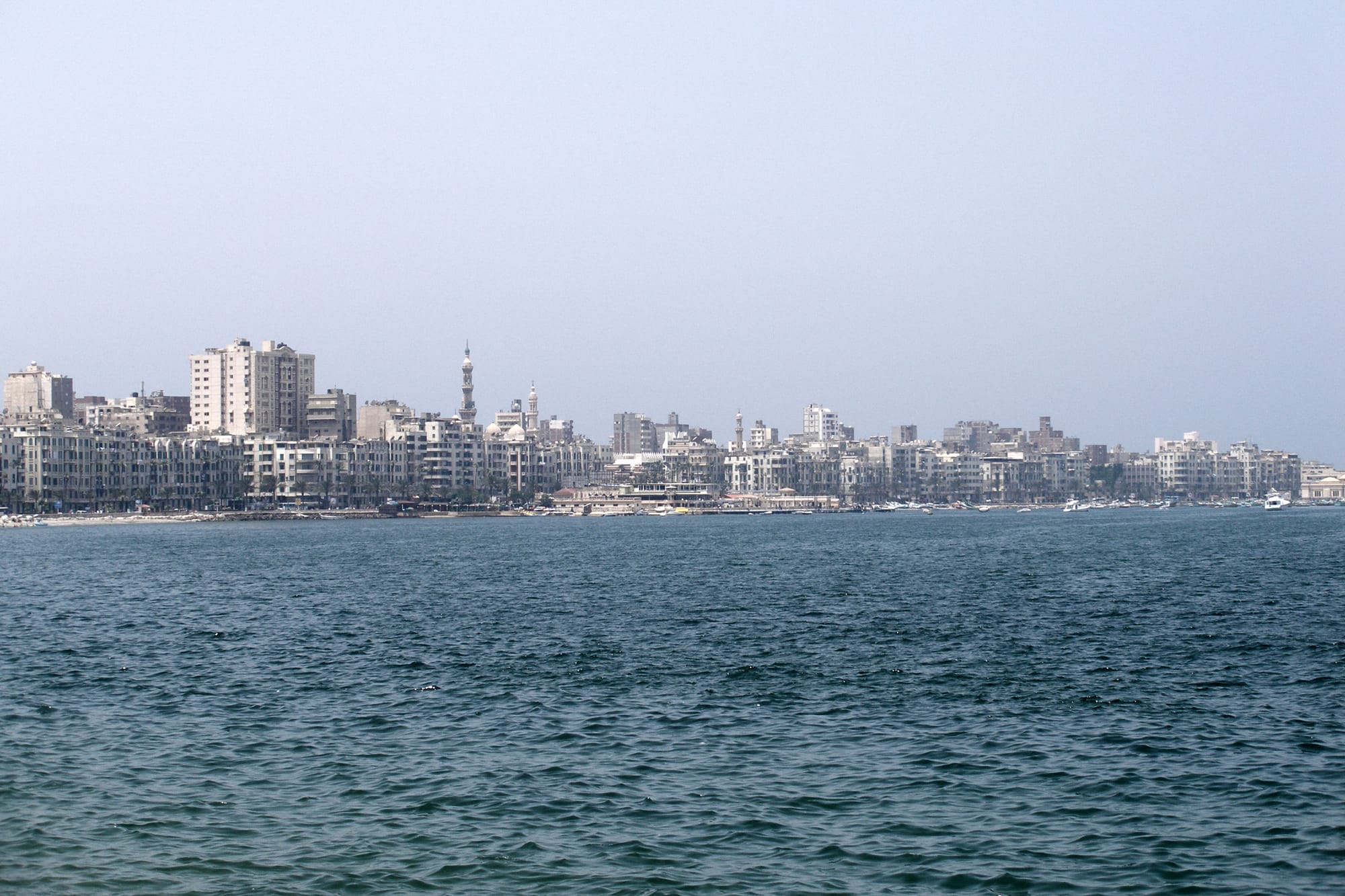
Above: The Eastern Harbour of Alexandria, where the ancient Portus Magnus lay. (Alexandria, Egypt: © Vyacheslav Argenberg (CC BY 4.0))
A team excavating underwater in Alexandria's eastern port has announced a small bronze object with an outsized subject: a ring-signet bearing a relief of the Lighthouse of Alexandria.
The European Institute for Underwater Archaeology (IEASM), led by Franck Goddio, announced the find on 7 October 2026. In its words, the ring is "the first of its kind known to exist".
Where it was found
The ring came from the site of the palace on the submerged Royal Island of Antirhodos, which the institute says was once part of the Royal Quarters of Alexandria's Portus Magnus. The find was made during the institute's ongoing underwater excavations. According to the institute, the relief of the lighthouse has iconography similar to that found on some 2nd-century AD coins.
The institute says the minister of tourism and antiquities, Sherif Fathy, and his assistant Dr Ahmed Rehema visited the team aboard the research vessel to watch this year's underwater fieldwork and to see the discovery in person.
What the excavators say it means
Goddio stressed the setting. "The discovery of the ring-signet is even more important as it has been excavated in the legendary palace of the Island of Antirhodos, that once was a centre of power," he said.
The institute went further. It says the ring demonstrates that the palace, which Strabo saw on his visit to Egypt between 29 and 25 BC, had at some point offices for administrative functions, including the administration of the famous lighthouse. It adds that the excavations on Antirhodos are revealing architectural remains across an area of several thousand square metres.
The Egyptian side of the story
Speaking on the Extra News programme This Morning, as reported by Al-Masry Al-Youm, Rehema said the mission works under the Supreme Council of Antiquities' underwater antiquities department, on an excavation licence held by the IEASM, and has been active in the eastern harbour area since 1992. He said the work covers four sites, including two on the Royal Island of Antirhodos, alongside the remains of the obelisk, the Timonium (known as Antony's palace) and the temple area.
Rehema said the ring matters because images of the lighthouse had previously been found mainly on coins dating to the 2nd century AD. Its appearance on a signet ring is a new discovery, he said, one that adds to historical knowledge of the area.
He also said the find is evidence that the palace on Antirhodos remained in use until the 2nd century AD. He considered it likely that the ring was connected to an administrative official, or to the administrative group responsible for running the lighthouse, who may have worked from Antirhodos or had their base there.
Reading the find
The ring is a small object, but the claim attached to it is a specific one: an image of a lost ancient landmark, on an item the excavators link to administrative use, from a palace site they say is still yielding architecture. The link to lighthouse administration is the excavators' and Rehema's interpretation rather than something the ring states on its face, and fuller publication of the object will show how far it holds.
Sources
جيلان محمد (2026) '«السياحة والآثار» تكشف تفاصيل العثور على «خاتم برونزي» يحمل نقشًا لفنار الإسكندرية (فيديو)', Al-Masry Al-Youm, 7 October 2026, available at: https://www.almasryalyoum.com/news/details/4377094 (Accessed: 9 October 2026).
European Institute for Underwater Archaeology (IEASM) / Franck Goddio (2026) 'New find in the eastern port of Alexandria: First known bronze ring-signet depicting the city's famous lighthouse uncovered', Franck Goddio, 7 October 2026, available at: https://www.franckgoddio.org/service/newsletter/detail/new-find-in-the-eastern-port-of-alexandria/ (Accessed: 9 October 2026).