
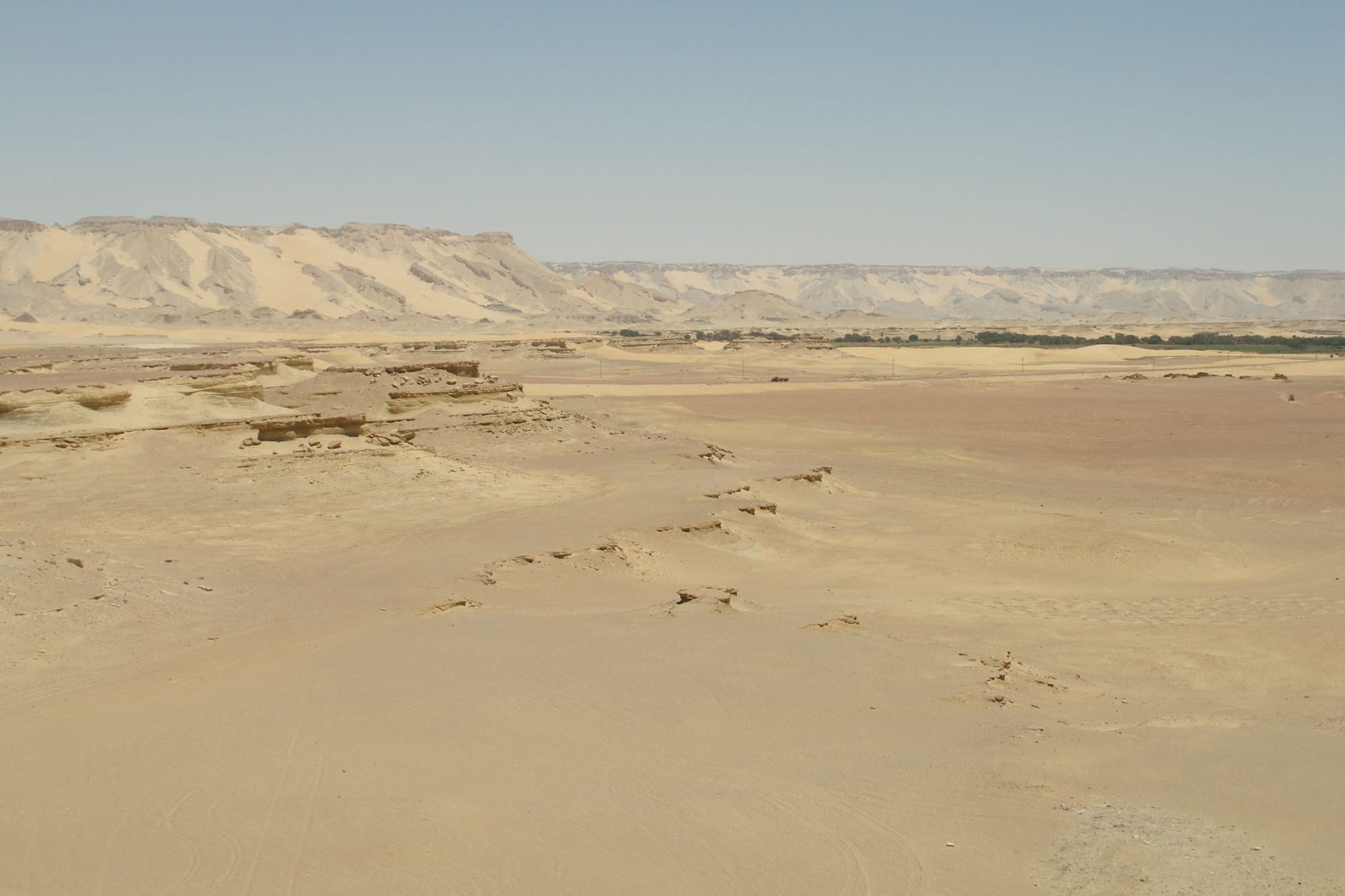
On 25 September 2026, Egypt's Ministry of Tourism and Antiquities announced that an Egyptian mission from the Supreme Council of Antiquities had uncovered a pyramid-shaped, mud-brick tomb of the Roman period at Bir al-Shaghala, in Dakhla Oasis, New Valley Governorate. The tomb was built for a man and his wife. Its entrance is dressed in Egyptian hieroglyphic spells, while a stone slab set into its wall carries a funerary poem in Ancient Greek, written in red ink.
An Egyptian doorway, a Greek poem
According to the ministry's announcement, the approach is a staircase of 14 steps leading to a sandstone entrance built in the Egyptian style. Incised hieroglyphs on it carry funerary spells meant to protect the dead. Mohamed Abdel Badie, head of the Egyptian Antiquities Sector at the Supreme Council, is the official the announcement credits with describing the entrance. The entrance is topped by a cornice showing a winged sun disk flanked by two cobras, followed by an element shaped like a bundle of reeds. When the team reached the doorway it was sealed by a stone slab bearing an Osiris-like figure surrounded by spells.
Inside, a transverse mud-brick hall with a vaulted ceiling leads to two plaster-coated mud-brick burial chambers on its right. Part of the ceiling had collapsed on the western side. The pyramid form rises above the chambers.
The ministry says the lintel above the door shows a rare funerary scene that had not been seen before in the tombs of this cemetery: the seventh hour of the Amduat, one of ancient Egypt's books of the netherworld. Smithsonian Magazine, citing the Royal Collection Trust, says this section of the text finds the sun god Ra facing "the most terrifying being of the netherworld: Apophis, the great serpent blocking his passage". Archaeology Magazine, summarising the find, refers only to a scene from the Books of the Netherworld.
The elegy, and the man it names
The ministry describes a rectangular stone stele set into the southern wall of the pyramidal structure. Its top is shaped as a pediment with a sun disk carved in relief. It bears a 19-line funerary elegy in Ancient Greek, in red ink, dated to the late third or early fourth century AD. The ministry says it is evidence of a thriving literary and cultural life in the oasis under Roman rule.
The poem is dedicated to a man whose name is transliterated in different ways: Pisechtes (Archaeology Magazine, Smithsonian), Psychtis (Ancient Origins, Smithsonian) and Pesikhtis (Archaeology Wiki). The ministry says preliminary study indicates he may have been a judge. Each of the reports cited here keeps that hedge, and so does this article.
Smithsonian's account adds more about the poem's content, drawing on Angelos Chaniotis, a classicist at the Institute for Advanced Study in New Jersey who was not involved in the excavation. According to Smithsonian, he told Live Science that the text describes Pisechtes as an adviser in life, known for kindness and wisdom, and that in the closing lines Pisechtes' son Sarapion speaks to him directly: "Listen, father!" Chaniotis calls the work "a highly literary and original epigram" and points to its use of diacritical marks, which he says show the author's high level of education.
That address from son to father is the human centre of the find. My own reading is that this is the story's real interest, more than the pyramid shape: the tomb carries Egyptian spells at its doorway and a Greek poem on its stele, side by side.
Finds, and signs of reuse
The ministry lists a sandstone offering table above a sandstone purification basin, pottery vessels and a bronze coin with a relief portrait of the Roman emperor Constantine. Ancient Origins notes that the announcement does not say the coin fixes the date of the first burial.
The ministry also says the evidence points to the possibility that the tomb was reused later. Above the main entrance the team found a mud-brick chapel, with a funerary shrine in front of it that has four square mud-brick columns.
The cemetery of Mothis
According to the announcement, Bir al-Shaghala is one of the cemeteries of Mothis, modern Mut, the oasis capital in the Ptolemaic and Roman periods. Supreme Council excavations there began in 2002 and have revealed tombs of varying plans and styles. The ministry says their features and decoration suggest the cemetery may have been used for members of the capital's elite in the Roman era. Some chambers are decorated with texts and scenes from the Books of the Netherworld alongside Greek and Roman elements.
Minister Sherif Fathy said the discovery reflects the archaeological and cultural richness of Egypt's oases. Hisham El-Leithy, Secretary-General of the Supreme Council, said the tomb's architecture, inscriptions and funerary texts offer important information on funerary practice and on cultural and religious life in Dakhla during the Roman period.
Sources
Archaeology Magazine (2026) 'Pyramid-Shaped Tomb Unearthed in Egypt's Dakhleh Oasis', Archaeology Magazine, 25 September 2026, available at: https://archaeology.org/news/2026/09/25/pyramid-shaped-tomb-unearthed-in-egypts-dakhleh-oasis/ (Accessed: 25 October 2026).
Archaeology Newsroom (2026) 'Roman-era pyramid-shaped tomb discovered in Dakhla Oasis', Archaeology Wiki, 28 September 2026, available at: https://www.archaeology.wiki/blog/2026/09/28/roman-era-pyramid-shaped-tomb-discovered-in-dakhla-oasis/ (Accessed: 25 October 2026).
Manners, G. (2026) 'Roman Pyramid Tomb in Dakhla Oasis Bears Rare Greek Poem', Ancient Origins, 27 September 2026, available at: https://www.ancient-origins.net/news-history-archaeology/roman-pyramid-tomb-dakhla-00103210 (Accessed: 25 October 2026).
Ministry of Tourism and Antiquities (2026) 'كشف أثري جديد بمنطقة بئر الشغالة بالواحات الداخلة بالوادي الجديد' [A new archaeological discovery in the Bir al-Shaghala area of Dakhla Oasis, New Valley], Ministry of Tourism and Antiquities, Egypt, 25 September 2026, available at: https://mota.gov.eg/ar/%D8%A7%D9%84%D8%A3%D8%AE%D8%A8%D8%A7%D8%B1-2-1-1/%D9%83%D8%B4%D9%81-%D8%A3%D8%AB%D8%B1%D9%8A-%D8%AC%D8%AF%D9%8A%D8%AF-%D8%A8%D9%85%D9%86%D8%B7%D9%82%D8%A9-%D8%A8%D8%A6%D8%B1-%D8%A7%D9%84%D8%B4%D8%BA%D8%A7%D9%84%D8%A9-%D8%A8%D8%A7%D9%84%D9%88%D8%A7%D8%AD%D8%A7%D8%AA-%D8%A7%D9%84%D8%AF%D8%A7%D8%AE%D9%84%D8%A9-%D8%A8%D8%A7%D9%84%D9%88%D8%A7%D8%AF%D9%8A-%D8%A7%D9%84%D8%AC%D8%AF%D9%8A%D8%AF (Accessed: 25 October 2026).
Solly, M. (2026) 'Archaeologists in Egypt Discover a Mud-Brick Tomb Featuring a Heartbreaking Elegy to an Ancient Man's Father', Smithsonian Magazine, 14 October 2026, available at: https://www.smithsonianmag.com/smart-news/archaeologists-in-egypt-discover-a-mud-brick-tomb-featuring-a-heartbreaking-elegy-to-an-ancient-mans-father-180989677/ (Accessed: 25 October 2026).
Picture credits
- Top picture: Desert landscape near Dakhla Oasis, in Egypt's Western Desert. Image: Desert landscape near Dakhla Oasis, Egypt — Vyacheslav Argenberg, CC BY 2.0 (via Wikimedia Commons)
- Map: drawn from Natural Earth (public domain) and Wikidata.
