
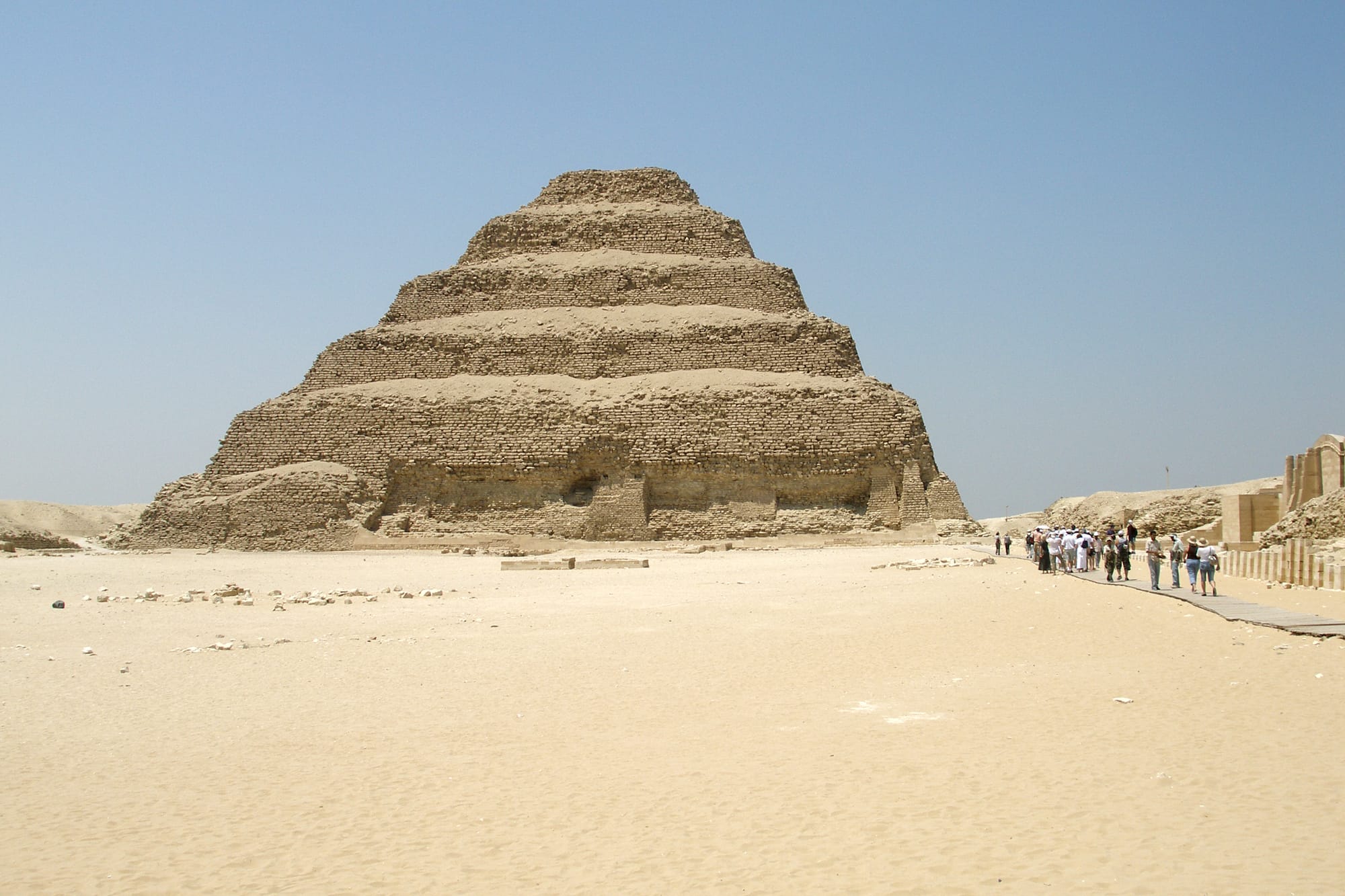
Egyptology has no settled account of how the pyramids were raised. The authors of a 2024 paper in PLOS ONE say there is "no generally accepted wholistic model for pyramid construction", and they offer a striking new candidate for the oldest of them. It is a water-powered lift inside the Step Pyramid of Djoser, fed by a dam and a water-treatment system. It is a hypothesis, not a finding, and the experts who commented on it were mostly unconvinced. Its lead author, Xavier Landreau, told Ars Technica he is sceptical that the largest pyramids were built using only ramps and levers.
What the paper proposes
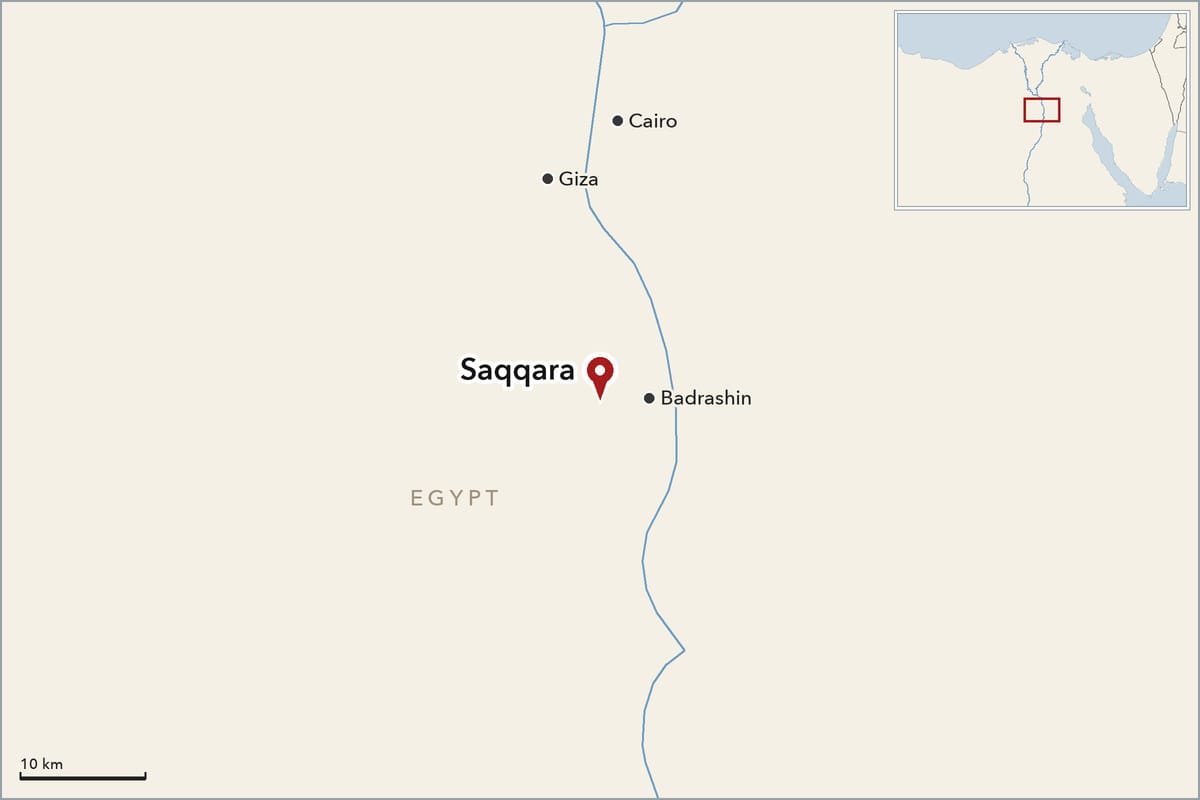
The study, by Landreau, of Paleotechnic in Paris, and nine co-authors, was published on 5 August 2024. It treats the Step Pyramid, built at Saqqara around 2680 BC for Djoser, as a precursor to the later and larger pyramids. The authors put the average weight of its blocks at about 300 kg. Science News gives its height as roughly 62 metres.
The chain of argument has three links.
A dam. The authors map the drainage west of Saqqara and argue that the Gisr el-Mudir, a large rectangular enclosure a few hundred metres west of Djoser's complex, has the features of a check dam, built to trap sediment and water. They note that earlier explanations for the enclosure conflict: an unfinished pyramid complex, a fortress, a celebration arena, even a cattle enclosure. In their words, no generally accepted explanation exists and its purpose "has remained more conjectural than substantiated". Their water supply is the Abusir wadi, an ephemeral stream draining the hills to the west, with the nearby Wadi Taflah as a possible extra source. Their rainfall figure, 50 to 150 mm a year, is an assumption they describe as a "crude" first-order computation.
A water-treatment system. South of the pyramid, the authors say, the "Deep Trench" has the layout of a settling basin, a retention basin and a purification system. They describe it as about 27 metres deep and 3 metres wide, with a probable length of 410 metres, of which only about 240 metres has been excavated. Earlier readings of the trench were as a quarry or a place of ritual significance.
A lift. Inside the pyramid, they argue, the internal architecture is consistent with a hydraulic elevation mechanism that has never been reported before. Science News describes their proposed set-up. A wooden float sits in a large shaft and is tied by ropes over pulleys to a platform. Water flowing in through a granite chamber raises the float, and draining the shaft hauls the loaded platform up. CNN notes that the granite box at the base of the shaft is more widely believed to be Djoser's burial chamber, and that the authors instead suggest it was built to open and close the lift.
The authors do not claim water did everything. According to the PLOS press statement carried by ScienceDaily, they suggest ramps were probably also used, with a hydraulic lift supporting construction "when there was enough water". Landreau told Ars Technica the start of construction could have used ramps.
Why the story travelled
The paper was covered widely. Live Science reported on 30 July 2024 on a version of the research posted to ResearchGate, when it had not yet been peer reviewed; the PLOS ONE paper followed on 5 August 2024. In the Live Science report, Landreau called the work "a watershed discovery". Popular Mechanics ran its own account on 29 March 2026, headlined as solving a 4,500-year-old mystery. Even that piece says the paper "suggests" the pyramid was built this way and that the claim is "if proved out".
What the critics say
The objections are specific.
- Water supply. University of Toronto archaeologist Oren Siegel argued, as Science News reported, that the Gisr el-Mudir could not have held enough water from occasional rains to run the system. He suggested it may instead be an early experiment in stone enclosures. Fabian Welc of Cardinal Stefan Wyszyński University told CNN that winter rains in the Third Dynasty were of relatively low intensity and that, in his view, the water would have drained away into the rock. David Jeffreys, retired from University College London, told CNN the wetter phase of the Sahara most likely ended by the start of the third millennium BC. Judith Bunbury of Cambridge, by contrast, told CNN she thought there might have been enough water, and that a rainier early Old Kingdom was a fairly widespread belief.
- Effort. Kamil Kuraszkiewicz of the University of Warsaw told Science News that Djoser's stones were far easier to move than those of later pyramids, and that building the proposed device would demand much more effort than hauling the blocks by manpower.
- No record. Kuraszkiewicz also noted that the proposed lake appears in no ancient Egyptian writing. Bunbury told Ars Technica that Egyptians used other hydraulic technologies at the time but that there is no evidence of any hydraulic lift, and that she would want images or texts showing one. She told CNN that "there's a sort of Occam's razor of what's the simplest thing based on what we already know".
- Who did the work. Julia Budka of Ludwig Maximilian University of Munich told Live Science her biggest concerns were that no Egyptologists or archaeologists were directly involved, and that the authors question the use of the pyramid as a burial site. Her verdict on the version Live Science covered: "Scientifically, their hypothesis is not proven at all".
- Agnosticism. Oxford's John Baines told Ars Technica he was "agnostic to skeptical". He called the paper very thorough, but said ramps are known to work and have archaeological support elsewhere.
Where it stands
This is my view, not a finding. The sceptics have the better of the argument on the evidence available. No text, image or surviving device shows such a lift, and the water budget rests on assumed rainfall. But the paper does ask something specific that can be tested. Landreau's own list of next steps, reported by Ars Technica, includes geophysical surveys, coring of the wadi, and excavation around the Gisr el-Mudir and the Deep Trench. The paper says about 170 metres of the trench remains unexplored, and that the upper part of the north shaft, inside the pyramid, remains unexplored too. Those digs could clarify whether the Gisr el-Mudir and the Deep Trench ever had hydraulic uses. That is the fair test, and nobody has to take a side in advance to want it run.
Sources
Ars Technica (Ouellette, J.) (2024) 'Study suggests Egyptians used hydraulic lifts to build Pyramid of Djoser', Ars Technica, 5 August 2024, available at: https://arstechnica.com/science/2024/08/did-ancient-egyptians-use-a-hydraulic-lift-to-build-the-pyramid-of-djoser/ (Accessed: 21 October 2026).
CNN (2024) 'How did ancient Egyptians stack those heavy stones of the oldest pyramid? Scientists float new theory', CNN, 5 August 2024, available at: https://www.cnn.com/2024/08/05/science/egypt-pyramid-hydraulic-lift-technology-theory (Accessed: 21 October 2026).
Landreau, X., Piton, G., Morin, G., Bartout, P., Touchart, L., Giraud, C., Barre, J.-C., Guerin, C., Alibert, A. and Lallemand, C. (2024) 'On the possible use of hydraulic force to assist with building the step pyramid of saqqara', PLOS ONE, 19(8): e0306690, 5 August 2024, available at: https://journals.plos.org/plosone/article?id=10.1371/journal.pone.0306690 (Accessed: 21 October 2026).
Live Science (Nalewicki, J.) (2024) 'Ancient Egyptians used a hydraulic lift to build their 1st pyramid, controversial study claims', Live Science, 30 July 2024, available at: https://www.livescience.com/archaeology/ancient-egyptians/ancient-egyptians-used-a-hydraulic-lift-to-build-their-1st-pyramid-controversial-study-claims (Accessed: 21 October 2026).
PLOS (2024) 'Hydraulic lift technology may have helped build Egypt's iconic Pyramid of Djoser', ScienceDaily, 6 August 2024, available at: https://www.sciencedaily.com/releases/2024/08/240805164414.htm (Accessed: 21 October 2026).
Popular Mechanics (Newcomb, T.) (2026) 'Engineers Found Evidence of Hydraulics in an Ancient Pyramid, Solving a 4,500-Year-Old Mystery', Popular Mechanics, 29 March 2026, available at: https://www.popularmechanics.com/science/archaeology/a70875632/ancient-egyptian-pyramid-hydraulic-system-discovered/ (Accessed: 21 October 2026).
Science News (Bower, B.) (2024) 'Was Egypt's first pyramid built with hydraulics? The theory may hold water', Science News, 5 August 2024, available at: https://www.sciencenews.org/article/hydraulic-lift-egypts-first-pyramid (Accessed: 21 October 2026).

