
In three offering scenes inside the tomb of an Egyptian official named User at Thebes, a collared dog sits upright beneath his chair. Two of the dogs have had names on record since 1913. The third had apparently remained anonymous, because the inscription above and behind its head had faded almost into the painted wall. Egyptologist Chelsea Kaufman has now recovered the name in a study in The Journal of Egyptian Archaeology.
A name read from almost nothing
The name is dwA.ty, which Arkeonews translates as roughly "He-of-the-Underworld". La Brújula Verde renders it "The One of the Underworld". Both outlets report that Kaufman's study adds it as the 97th known dog name from ancient Egypt.
The method was digital rather than physical. Arkeonews reports that Kaufman re-examined the scene with DStretch, a plug-in for the ImageJ software that enhances differences in surviving pigment, and that the hieroglyphs became much clearer once the image was processed. La Brújula Verde adds that the photographs came from J. J. Shirley, director of the TT 110 project, and that after enhancement the name stood out clearly against the yellow wall. La Brújula Verde identifies Kaufman as being at Johns Hopkins University.
Davies, who published the tomb, recorded the names of only two of the dogs, La Brújula Verde reports. Arkeonews gives them as "Strong one" and "Trusty". The third dog is on the east wall, to the left of the entrance.
What the name means, and what it doesn't prove
According to Arkeonews, Kaufman interprets dwA.ty as a derived adjective referring to origin. La Brújula Verde calls this form a nisbe and says it points to the Duat, the realm of the dead. The same word is also known as an epithet of Anubis, the god linked to embalming and to the protection of the dead.
Kaufman considers it very likely that the name refers to Anubis, La Brújula Verde reports. Arkeonews describes her as arguing that the name likely alludes to him. Arkeonews stresses the limit of the evidence. It says the inscription does not prove User named his dog directly after the god, only that the strongest linguistic and contextual reading points toward the realm of the dead.
There is a rival reading. Both outlets report that one sign carries two phonetic values, so the name could in theory be read sbA.ty, "pupil". Kaufman finds that less convincing in a funerary setting. La Brújula Verde lists her reasons:
- sbA.ty is not recorded as a name, human or otherwise.
- The context is funerary.
- At least one case of dwA.ty is known as a personal name.
That last point has a sting in the tail. La Brújula Verde reports that a variant of the name appears once as a personal name, but never before as a dog's. Kaufman's reading is a judgement on a faint inscription, and she has argued it with its alternative in view.
The tomb and its owner
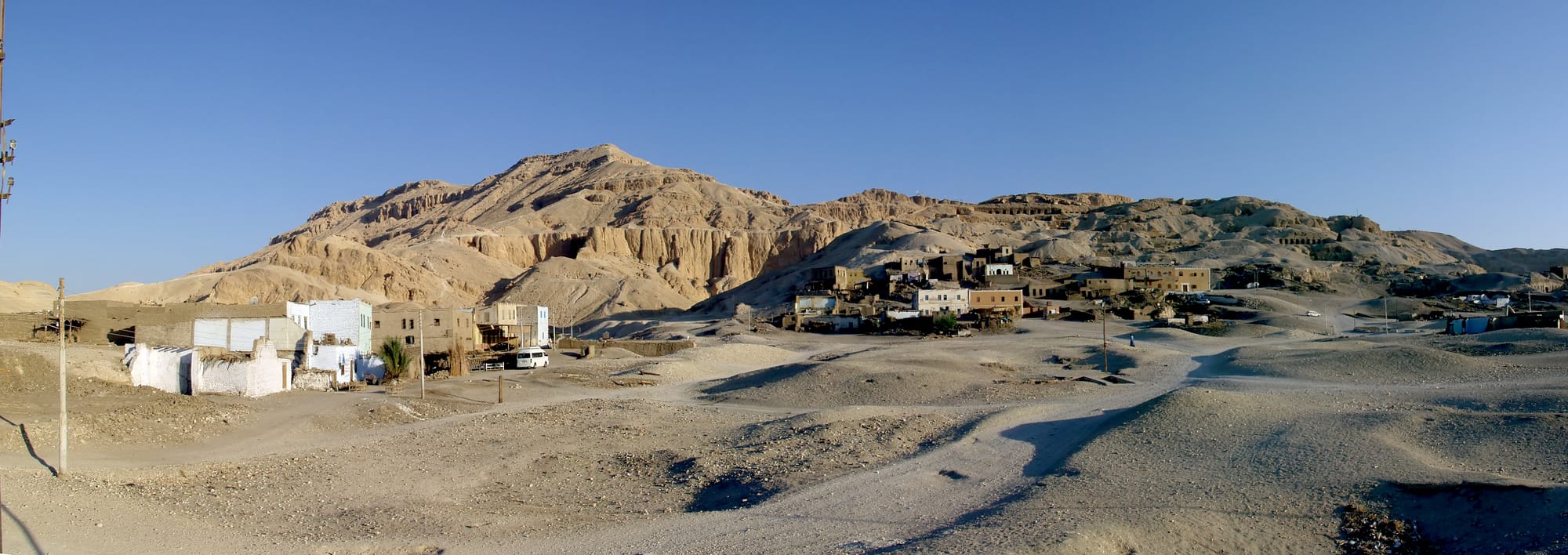
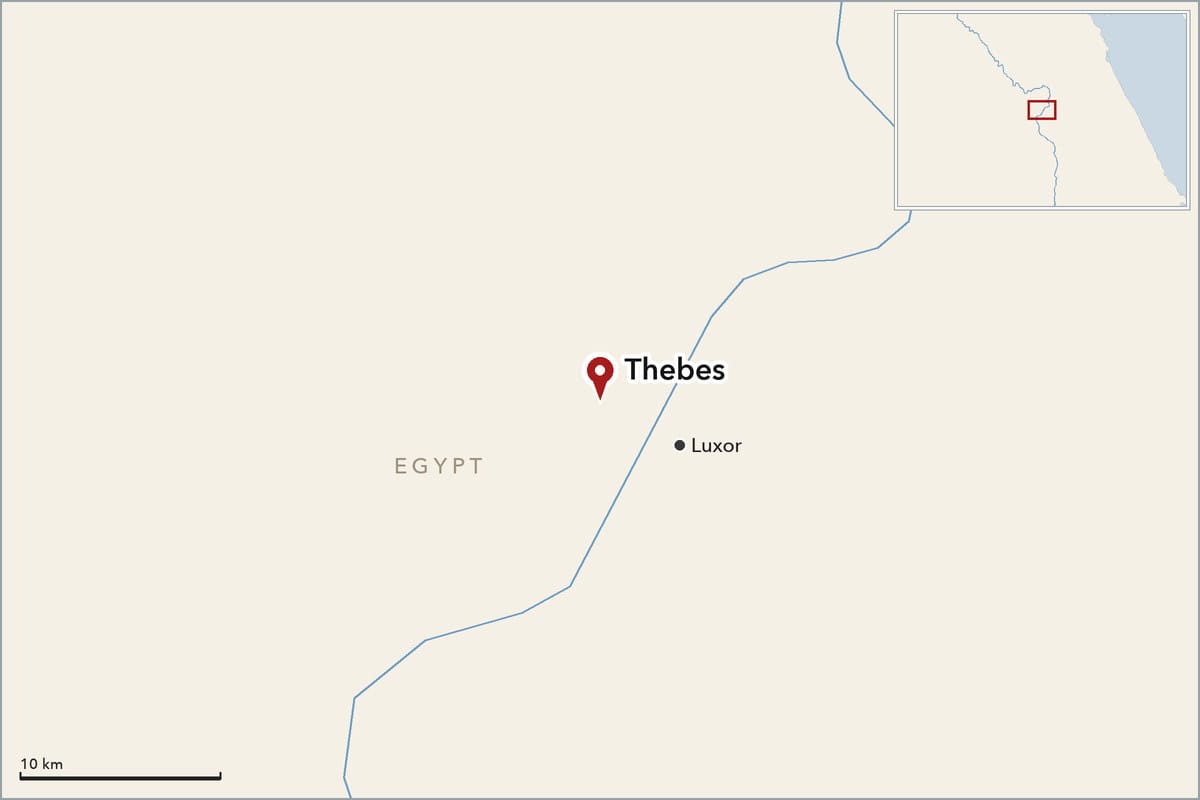
The tomb is TT 21 at Thebes. La Brújula Verde places it in the Sheikh Abd el-Qurna necropolis on the west bank of the Nile, near modern Luxor. Arkeonews describes User as a scribe and steward of the early 18th Dynasty, and his tomb as generally associated with the reign of Thutmose I. It adds that some scholars have argued the decoration may have continued into the reign of Hatshepsut.
La Brújula Verde gives the detail. It says Porter and Moss place the tomb in the reign of Thutmose I, about 1504–1492 BC, on the strength of User's title. It says Davies suggested the tomb may not have been finished until Hatshepsut's reign, about 1473–1458 BC.
The inner chamber has surviving offering scenes in which a dog sits beneath the owner's chair. La Brújula Verde says there are four scenes in all, at least three with a dog. Both outlets describe the animals as the slim, athletic sloughi type, with drooping ears.
A dog painted to stand apart
By the reports' account, the third dog was made distinctive in several ways. Arkeonews says it has a white coat marked with red, rippling bands. Kaufman describes the pattern as resembling brindling and echoing the rippled fabric User wears. To her knowledge, no comparable coat appears on other dogs in Egyptian art.
The spelling is unusual too. Dog names that take a determinative, a classifying sign at the end of a word, usually use a standing dog. Here the sign is a seated dog, mirroring the pose of the animal painted below it. Only one other seated-dog determinative is currently known among Egyptian dog names, on a Middle Kingdom coffin now in the Royal Museums of Art and History in Brussels. Arkeonews reports that Kaufman stops short of assigning a precise meaning to the choice. La Brújula Verde reports that she regards it as evident that the artist meant to set this dog apart from the other two in the tomb.
Why a dog's name was worth writing down
Arkeonews and La Brújula Verde both report that nearly 100 dog names are known, from the Old Kingdom to the Ptolemaic Period. More than half come from private tombs. Many name a physical trait or a character trait, and a few carry religious associations. Some are also found as human names.
Kaufman's argument, as the outlets report it, is that a tomb image and a written name helped keep a being present in the afterlife. Arkeonews reports that she reads the pairing of image and name as an investment in the animal's continued existence after death. On that view, User was not merely decorating his burial place. This part is interpretation, but the evidence behind it is on the wall: a dog beneath its owner's chair in a tomb, with a name that was barely visible until it was digitally enhanced.
One thing here is a plain gain. A figure that earlier documentation left without a name now has one, recovered by enhancing the pigment that survives on the wall.
Sources
Altuntaş, L. (2026) 'A 3,500-Year-Old Egyptian Dog Had a Unique Name, an Unusual Coat, and a Rare Hieroglyph', Arkeonews, 3 October 2026, available at: https://arkeonews.net/a-3500-year-old-egyptian-dog-had-a-unique-name-an-unusual-coat-and-a-rare-hieroglyph/ (Accessed: 29 October 2026).
Carvajal, G. (2026) 'In Pharaonic Egypt Almost Only Dogs Got Names — A Faded Tomb Painting Has Just Revealed One Unlike Any Other', La Brújula Verde, 1 October 2026, available at: https://www.labrujulaverde.com/en/2026/10/in-pharaonic-egypt-almost-only-dogs-got-names-a-faded-tomb-painting-has-just-revealed-one-unlike-any-other/ (Accessed: 29 October 2026).
Kaufman, C. (2026) 'An 18th Dynasty Dog's Name from Thebes', The Journal of Egyptian Archaeology, advance online publication, available at: https://doi.org/10.1177/03075133261487455.
Picture credits
- Top picture. © Raimond Spekking / CC BY-SA 4.0 (via Wikimedia Commons)
- Map: drawn from Natural Earth (public domain) and Wikidata.
