
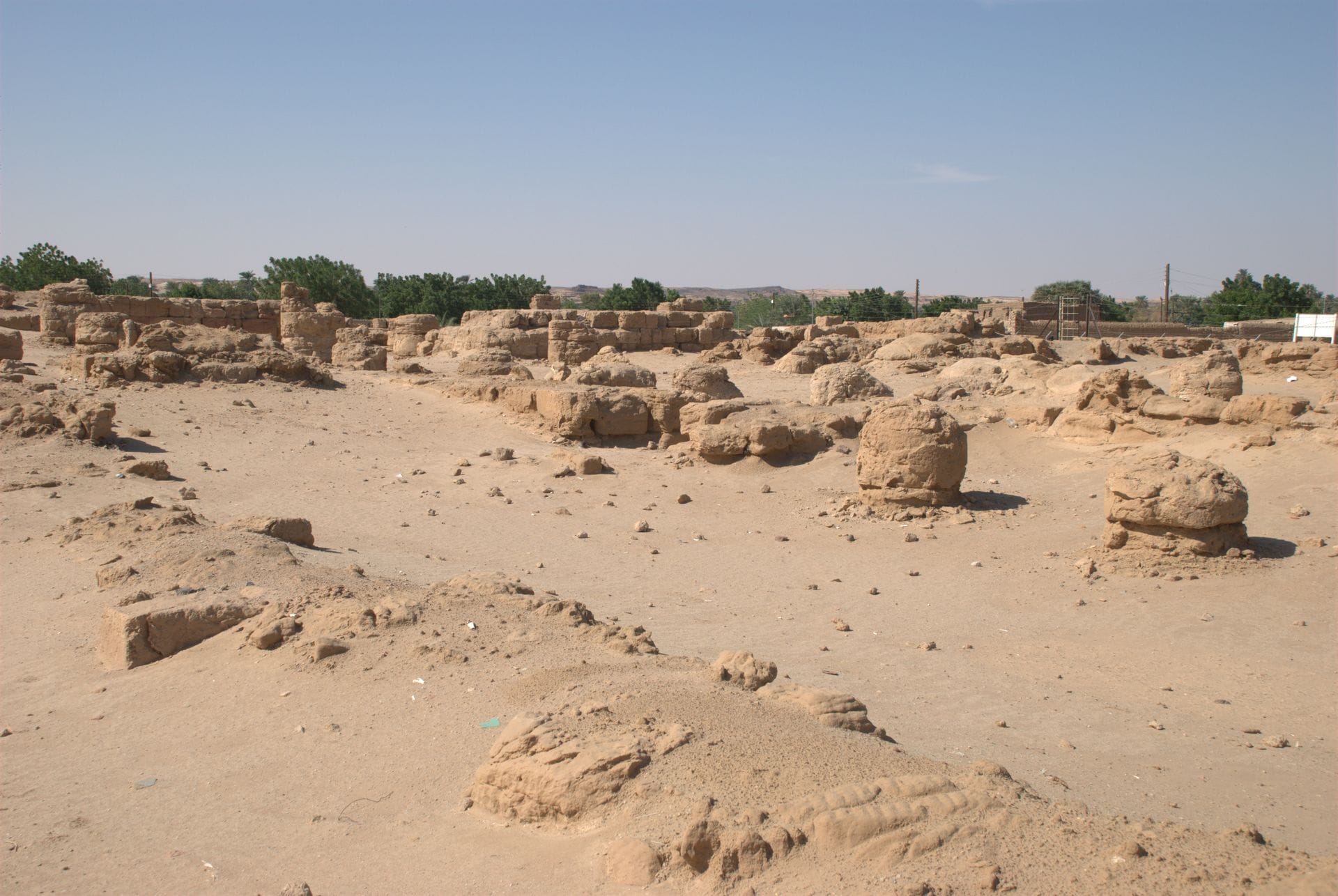
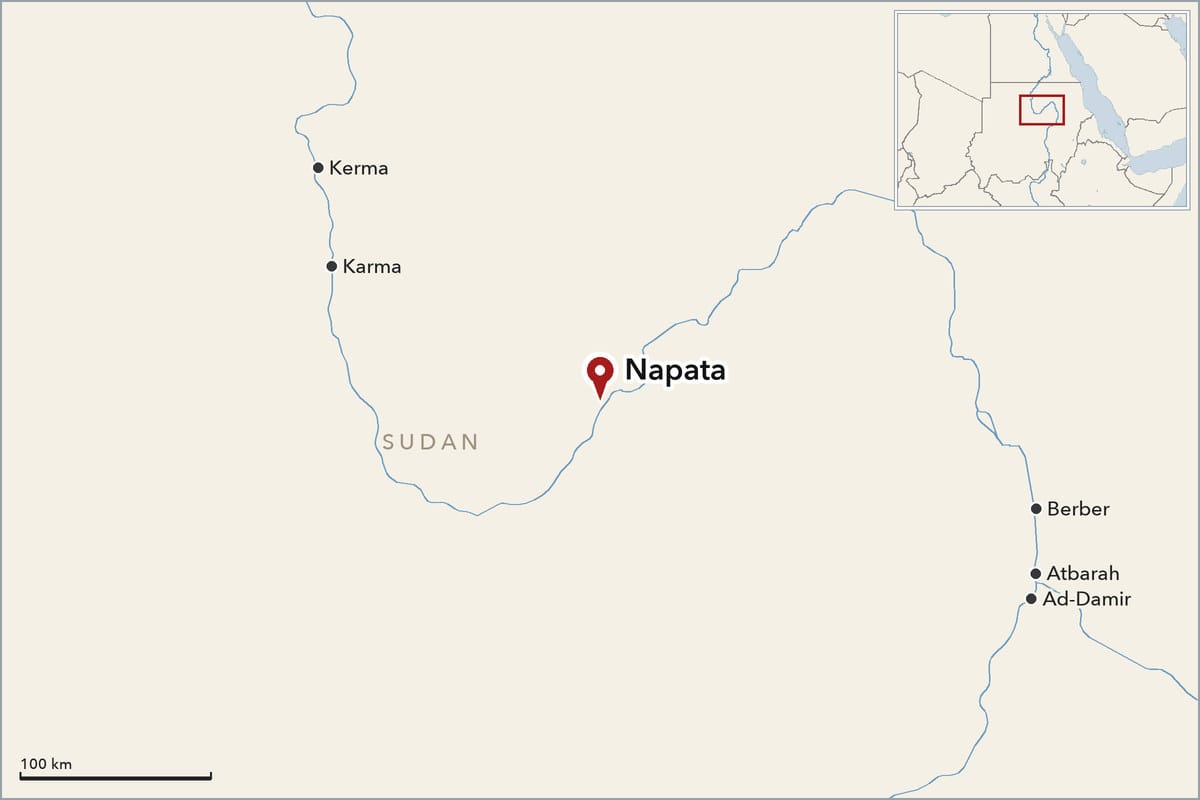
Behind a temple built by a Kushite king, archaeologists have found firing pits, mudbrick basins and thousands of shells. The excavators say these add up to a state-run workshop. In Antiquity, published online on 19 October 2026, Rennan Lemos (Durham University), Kathryn Howley (New York University), Siobhan Shinn (an independent scholar) and Shadia Abdu Rabo (National Corporation for Antiquities and Museums, Sudan) describe what they uncovered at Sanam Temple. The temple stands at Napata, which they identify as the capital of the Kushite Empire, in the Fourth Cataract area of the Nile in Sudan. They say King Taharqo (c. 690–664 BCE) built it.
What was found
The excavations ran from 2018 to 2020. The workshop sits in the north-east part of the site, immediately outside the sandstone temple. It comprises three firing pits dug in connection with two mudbrick basins. Beads, vessels and shabtis were made there, according to the paper. The team recovered hundreds of faience disk beads in blue, green and white, pieces of faience vessels, and wasters. The abstract dates the workshop to the mid-seventh century BCE.
Faience is a deliberately manufactured glassy material, made mainly from silica mixed with some alkali and lime and fired at fairly low temperatures. The authors note that experiments have shown the temperature needed, around 900°C, can be reached in simple kitchen-style ovens. They write that it is unclear whether industrial kilns stood here or whether the pits had removable covers. They still say the remains "clearly identify a formal temple workshop".
The authors describe it as the first securely identified faience-production workshop for the Middle Napatan Period (c. 780–656 BCE), and the first securely identified for Kushite Nubia.
The shells
The shells are the detail that carries much of the paper's argument. Thousands of small gastropod and bivalve shells came out of the ashy layers around the pits. The team reports grindstones too, and traces that the shells were crushed in the basins and mixed into the faience paste. Shell is a source of lime, and the authors say limestone is rare in Sudanese Nubia, which lies on the Nubian sandstone formation.
One of the shell types was a marine bivalve, most likely Transkeia globosa, which the authors describe as typical of the Red Sea. They argue that bringing in shells in such quantity points to state control over essential raw materials and to a locally adapted faience recipe. They add that it implies either direct control over distant communities and resources or the ability to negotiate with desert groups involved in long-distance transport. The gastropod shells could not be pinned down: the authors say species identification from shape alone is uncertain and that the ongoing war in Sudan prevents further analysis.
The link to Nuri
Early in the twentieth century, Francis Llewellyn Griffith excavated at Sanam and found clay moulds for shabtis and amulets. The new work reports a fresh clay shabti mould from inside the temple that exactly matches a fragmentary green faience shabti from the workshop. The authors also say Griffith's earlier moulds match faience shabtis that Reisner excavated at the royal necropolis of Nuri.
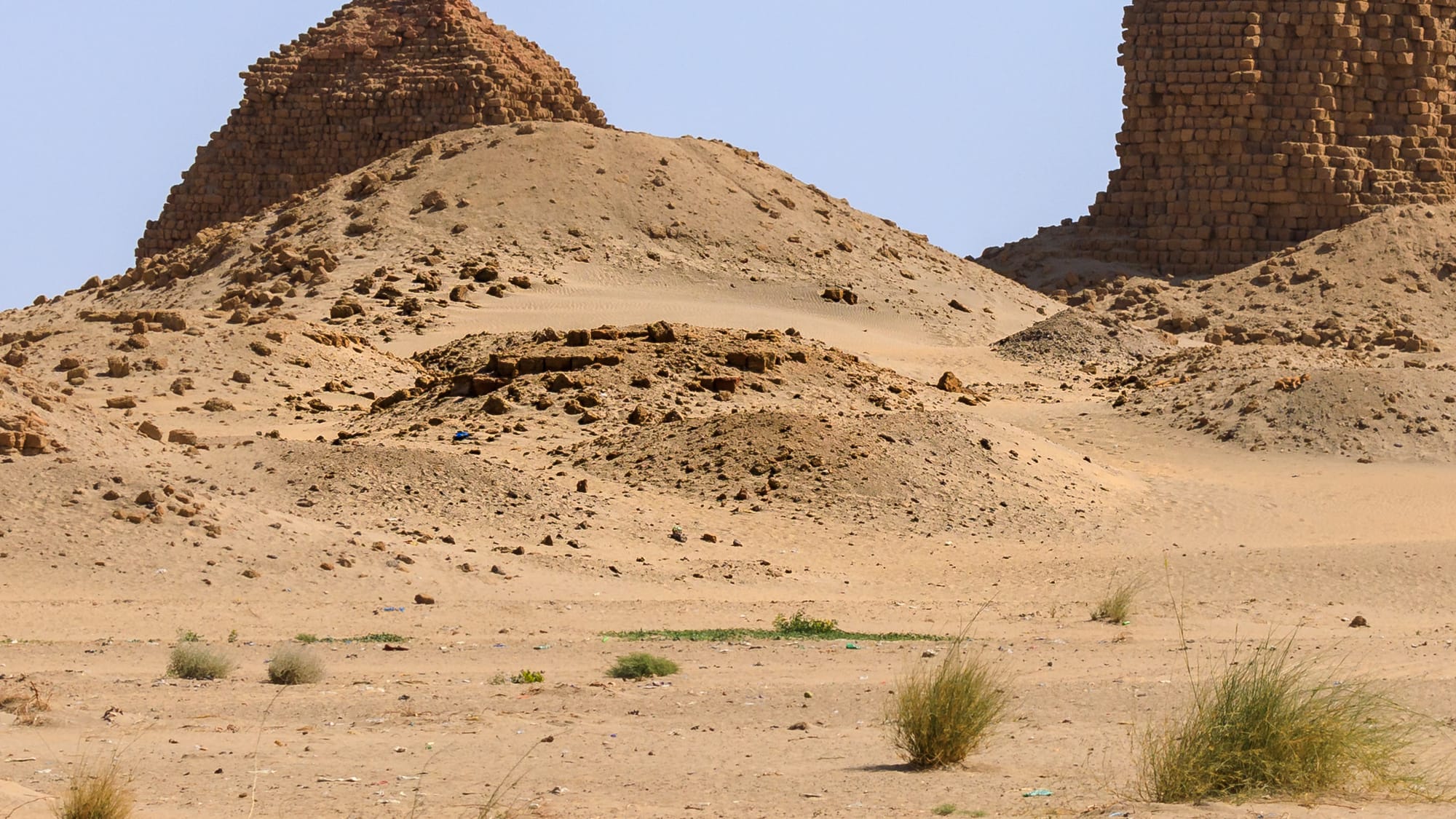
The authors treat shabtis as exclusively royal goods in Napatan Nubia. They conclude that their results "strongly suggest" the items found in the royal tombs of Nuri came from temple workshops like the one at Sanam. That is an inference from matching moulds, not a find of a Nuri shabti coming out of a Sanam kiln. It is also a conclusion the authors themselves word as "strongly suggest".
State control: the authors' argument
The phrase in the paper's title, state control, is the authors' interpretation of the evidence. Their reasoning runs as follows. The workshop sits against the temple wall, the shells were brought in from far away, and some of the products were meant only for royalty. Together these indicate to them that the Napatan state directed the procurement of raw material, the development of a local recipe and the manufacture of objects through temples.
In a statement released by Antiquity and quoted by Archaeology magazine on 20 October 2026, Lemos said: "This evidence demonstrates that Sanam Temple was not simply a religious monument but also a center of state-controlled production." Archaeology magazine reported that he added the workshop produced faience objects associated with royal power, including shabtis destined for the royal cemetery at Nuri.
The paper also points to a smell problem. It says faience firing would have produced unpleasant smells, depending on the fuel used, and that in Egypt workshops were often put at the edge of settlements so winds would carry fumes away. Placing this one so close to the temple suggests to the authors that the benefits of associating faience with royal authority outweighed the drawbacks.
The authors hedge their own case. Interpreting Middle Napatan faience production only through Sanam, they write, "risks giving an incomplete picture". They think it likely that non-state workshops supplied unrestricted faience items to wider social groups, and note that faience objects have also come from non-elite contexts at Napata. They wrote that the variety of recipes and techniques this would imply was yet to be fully investigated with scientific methods.
Beyond an Egyptocentric reading
The paper also has a line for readers who distrust how Egyptology frames the south. The authors say Griffith's interpretation of Sanam, based on his 1912 excavations, was biased. In their account this was partly because the royal tombs at el-Kurru and Nuri had not yet been excavated, and partly because of what they call Egyptology's dominant narrative of the history of the Nile Valley. They also criticise earlier interpretations that overemphasised the Napatan state's alignment with Egyptian models.
Their own reading of Sanam is more mixed. They argue Napatan Nubia did not simply replicate Egypt: the state drew on Egyptian traditions while developing a local faience recipe. My view is that the shells make this part of the paper the most concrete, because they are physical evidence of an adaptation to local conditions. The larger claim about how centralised the Kushite state was is an interpretation.
Sources
Archaeology Magazine (2026) 'Faience Workshop Found in Ancient Nubia', Archaeology Magazine, 20 October 2026, available at: https://archaeology.org/news/2026/10/20/faience-workshop-found-in-ancient-nubia/ (Accessed: 29 October 2026).
Lemos, R., Howley, K., Shinn, S. and Abdu Rabo, S. (2026) 'Crafting power in Kush: faience production and state control in the Napatan region', Antiquity, First View, published online 19 October 2026, DOI: 10.15184/aqy.2026.10434, available at: https://www.cambridge.org/core/journals/antiquity/article/crafting-power-in-kush-faience-production-and-state-control-in-the-napatan-region/A15CF88886CC39E3C6D4110DD58B94A5 (Accessed: 29 October 2026).
Picture credits
- Top picture. Photo: Bertramz, CC BY-SA 3.0 (Wikimedia Commons)
- Photo: Matthias Gehricke, CC BY-SA 4.0 (Wikimedia Commons)
- Map: drawn from Natural Earth (public domain) and Wikidata.

