
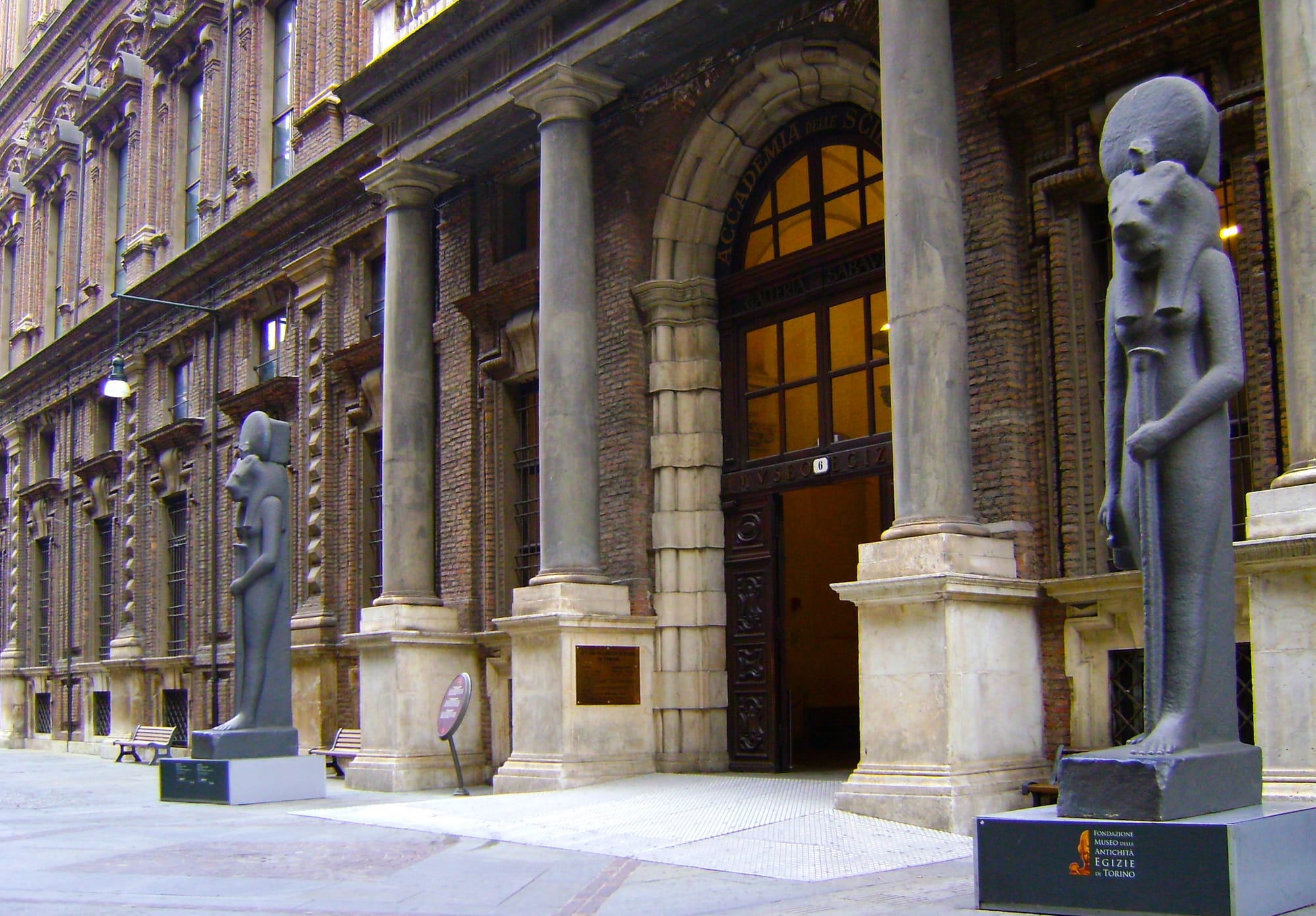
Italy's Council of Ministers has approved a measure to create the Istituto nazionale di ricerca egizia, a new autonomous public research body, on a proposal from Anna Maria Bernini, the minister for universities and research, and Alessandro Giuli, the culture minister, ANSA reported on 9 November 2026. According to ANSA, the institute is to strengthen and build on the scientific activities developed by the Fondazione Museo delle Antichità Egizie di Torino, and it is to have annual funding of €5.6 million.
What the institute is meant to do
ANSA reported that its work is to range from archaeology to conservation and advanced restoration of objects, and on to using new technologies to study and promote cultural heritage. Particular attention is to go to digital archaeology, artificial intelligence, data management and open science. The ministry for universities and research, MUR, said the aim is to consolidate the role of a body that is a reference point in the international scientific landscape, strengthening its research and making it more attractive to researchers, partly through new collaborations with Italian and international universities and scientific institutions, according to Artribune.
Bernini, quoted by ANSA, said a papyrus can still reveal words that researchers have not managed to read, and that an object can tell details of its history that have so far escaped them. She also said the Turin museum is, from that day, also a public research body, and that new discoveries and new skills are born from the dialogue between the humanities and sciences, cultural heritage and innovation.
The museum behind it
ANSA described the museum in Turin as the oldest in the world devoted entirely to Egyptian culture, one that has built a broad network of scientific collaborations and partnerships over the past ten years. EduNews24 reported that it opened to the public in 1824, starting from the Drovetti collection bought by King Carlo Felice of Savoy. EduNews24 added that since 2004 it has been run by a public-private foundation involving ministries and local bodies.
Artribune reported that the museum has been directed for twelve years by the Egyptologist Christian Greco, and that the request to set up the body came from Greco and the museum's president, Evelina Christillin, and had been put forward for almost ten years. Artribune quoted Greco as saying that becoming a public research body will let the museum strengthen its scientific activity, encourage archaeological excavations and take a leading role in European projects. Artribune also reported that, until now, research had been funded through the Foundation's budget, about €5 million of a total €21 million, and that the new resources would allow new investment and activity without depending only on the Foundation.
EduNews24 reported that the new status would allow direct agreements with Italian and foreign universities, joint doctoral programmes and direct access to the funding lines reserved for public research bodies in national and European calls. Artribune said Italian Egyptologists and university researchers welcomed the news with great satisfaction, and that among the reactions was the view that giving such attention to the humanities and ancient cultures is a very important gesture.
What the museum already does
ZON reported that the museum has thirty research projects under way, organised in five lines; four of the projects are excavation sites in Egypt. ZON also said the museum has produced about 200 scientific publications in the past five years. Sbircia la Notizia Magazine listed missions the museum takes part in at Qau el-Kebir, Saqqara, Deir el-Medina and Coptos.
On the digital side, Sbircia la Notizia Magazine reported that in April 2025 the museum began a trial with Fabbricadigitale of Vision Language AI applied to cataloguing, in which more than 650 stelae were examined to recognise figures, inscriptions, symbols and decorative motifs. It also described a programme called ME-Scripta, planned for 2026 to 2034, which is building a new digital infrastructure for Egypt's written culture. The project covers more than a thousand manuscripts and about thirty thousand fragments, produced over more than three millennia in seven writing systems and eight languages, according to the same outlet.
Where the legal process stands
Accounts of the legal status differ. inITALY reported on 12 November that the institute is a public body established by a decree that came into force on 12 November 2026. Sbircia la Notizia Magazine, in an article published on 13 November, reported that the Senate's 7th Committee approved the amendment creating the institute on 11 November 2026. At the time of its publication, that outlet said, the conversion law did not appear in the Gazzetta Ufficiale, and the institute would acquire legal existence only when the final text entered into force.
The same outlet reported that the Senate is due to discuss bill 2053 on 17 November 2026, after which it must go to the Chamber of Deputies. It added that decree-law 170 of 30 September must be converted by 29 November. EduNews24, on 9 November, reported that the government aims to close the process by the end of the year so that the new governance can start from the 2027 financial year, with the statute adopted and the institute's bodies appointed.
How the institute and the Foundation would divide the work
According to Sbircia la Notizia Magazine, the Foundation keeps running the museum and its dealings with the public, while the institute receives the public mandate for scientific activity on ancient Egypt and for museum work. The same outlet said the institute would receive rights to use the property and equipment needed for its scientific work, but not ownership of the collection. It also reported that the Foundation has been recognised as a research body since 2011, under a prime ministerial decree of 15 April of that year.
Sbircia la Notizia Magazine reported that the institute would be governed by the rules for public research bodies set out in legislative decree 218 of 2016. To start it up, the outlet said, a council of three experts would be appointed by joint decree of the two ministries. It added that there would be no automatic transfer for people who now work at the Foundation. The approved scheme provides annual funding from 2027, entered in the budget of the ministry for universities and research, Sbircia la Notizia Magazine said. inITALY said the money is intended for research and scientific projects rather than the day-to-day management of exhibition spaces.
Sources
Agenzia ANSA (2026) 'Museo Egizio diventa anche Ente pubblico di ricerca, via libera dal Cdm', Agenzia ANSA, 9 November 2026, available at: https://www.ansa.it/sito/notizie/cronaca/2026/11/09/museo-egizio-diventa-anche-ente-pubblico-di-ricerca-via-libera-dal_5be8736e-ed32-42d4-83b0-33e1aef264fe.html (Accessed: 13 November 2026).
Artribune (2026) 'Il Museo Egizio di Torino diventa anche Istituto nazionale di ricerca (5,6 milioni di fondi in più l’anno)', Artribune, 10 November 2026, available at: https://www.artribune.com/arti-visive/archeologia-arte-antica/2026/11/museo-egizio-torino-ente-pubblico-ricerca/ (Accessed: 13 November 2026).
Cristarella, J. (2026) 'Museo Egizio, approvato in Commissione l’Istituto di ricerca', Sbircia la Notizia Magazine, 13 November 2026, available at: https://www.sbircialanotizia.it/articoli/2026/11/13/museo-egizio-istituto-2jssj/ (Accessed: 13 November 2026).
inITALY (n.d.) 'Turin establishes a national institute for Egyptology research', inITALY, available at: https://www.initaly.it/en/articolo/a-torino-nasce-l-istituto-nazionale-di-ricerca-egizia-42786 (Accessed: 13 November 2026).
Labia, N. (2026) 'Il Museo Egizio di Torino diventa Istituto Nazionale di Ricerca Egizia', EduNews24, 9 November 2026, available at: https://edunews24.it/ricerca/istituto-nazionale-di-ricerca-egizia-5-6-milioni-l-anno-per-torino (Accessed: 13 November 2026).
ZON, R. (2026) 'Museo Egizio di Torino diventa ente di ricerca: l'Istituto nazionale parte con 30 progetti', ZON, 13 November 2026, available at: https://zon.it/museo-egizio-torino-istituto-ricerca-egizia/ (Accessed: 13 November 2026).
Picture credits
- Top picture: The Museo Egizio in Turin, whose research the new institute is meant to build on. Photo: Georgius LXXXIX, via Wikimedia Commons (public domain)
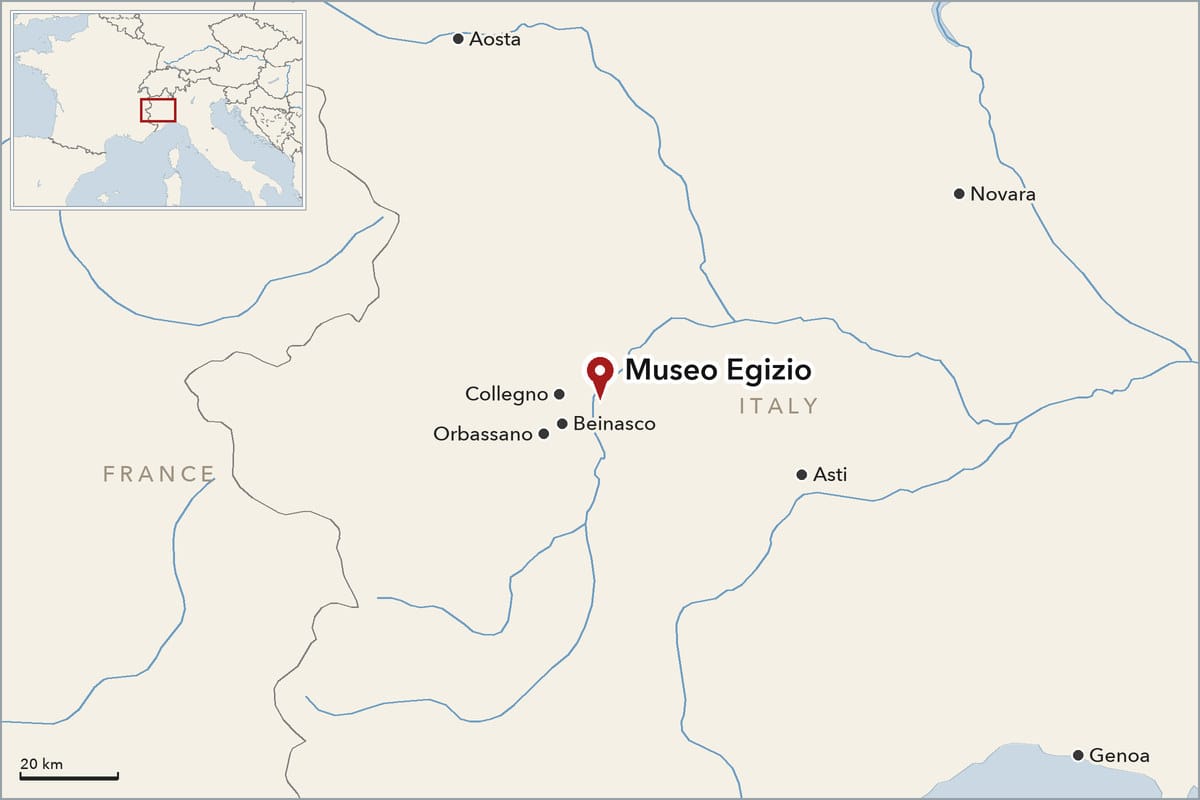
- Map: drawn from Natural Earth (public domain) and Wikidata.
