
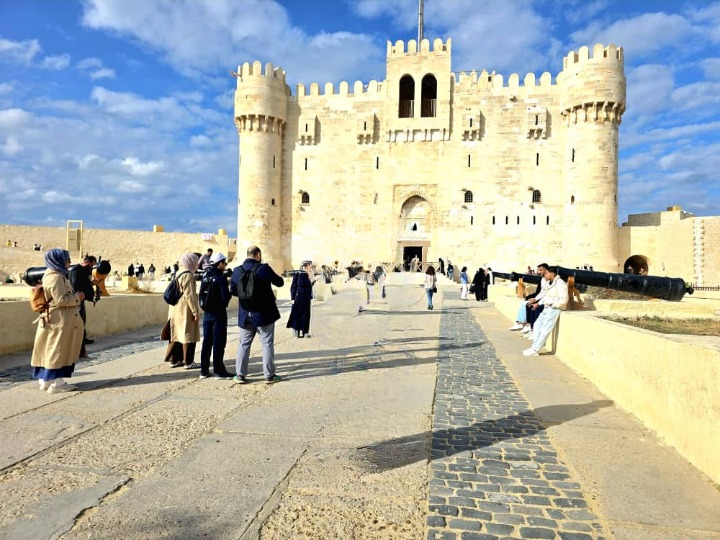
In June 2025, teams from the Centre d'Études Alexandrines (CEAlex) recovered some of the most imposing blocks of the Lighthouse of Alexandria from the waters of the city's port. Under the scientific supervision of CNRS archaeologist and architect Isabelle Hairy, the team lifted 22 of the lighthouse's largest stone blocks, according to La Fondation Dassault Systèmes. The CNRS, through its permanent unit in Egypt, CEAlex, conducts the excavation under the authority of the Egyptian Ministry of Tourism and Antiquities. The Daily Galaxy reported on 9 November 2026 that a crane mounted on a barge recovered the blocks.
What came out of the water
The recovered pieces include the lintel and jambs of the monumental gate, weighing between 70 and 80 tons, and its threshold. There were also large foundation slabs weighing up to 40 tons, and pieces of a previously unknown monument: an Egyptian-style pylon incorporating a Greek technique. La Fondation Dassault Systèmes also lists elements of the base borrowed from the pyramids of the Egyptian Old Kingdom. The Daily Galaxy, citing the excavation team, wrote that those stones had been taken from ancient pyramids that were already more than 2,000 years old when the lighthouse was constructed.
The aim of the operation, the Foundation said, was to study and scan these architectural elements and add them to more than 100 blocks already digitised underwater over the past decade. The Daily Galaxy says each recovered block was documented with photogrammetry, which produces accurate three-dimensional models from overlapping photographs. The wider site is large: according to the Foundation's project page, 4,896 stone blocks have been catalogued at depths of 4 to 9 metres, over about 2 hectares.
Filling the gaps
The Foundation says the underwater site represents only 10% of the original structure, leaving vast gaps. The lighthouse was quarried for building materials after it ceased operation in 1303, until the Qaitbay Fortress was built in 1477. To fill the gaps, the multidisciplinary Pharos team drew on ancient iconography (coins, terracotta lamps, mosaics and decorated glass) and on textual sources, particularly medieval Arabic-language documentation that, the Foundation says, describes the lighthouse's architecture with remarkable precision.
Hairy, volunteer engineers from La Fondation Dassault Systèmes and the engineer-Egyptologist Franck Monnier pooled their expertise to recreate a digital twin of the lighthouse. CEAlex says the Pharos project was launched in 2023 with the Foundation's support, and that three volunteer engineers help the team test hypotheses and refine the 3D models. The Foundation adds that Hairy and the engineers compared their analyses in the Teleport 1/1, a Dassault Systèmes immersive space for stepping into a full-scale virtual model. The same model is also used to validate the structure's mechanical strength against stresses such as earthquakes.
What the reconstruction shows
According to the Foundation, the exterior included a rising causeway supported by 16 arches and a monumental entrance gate 13 metres high, with a complex in three distinct volumes resting on a solid base. Inside, it describes 67 rooms across 9 levels, reached by a ramp wide enough for two horsemen to pass each other. The Daily Galaxy says the reconstruction reveals a monument far more elaborate than the familiar three-tiered tower shown on ancient coins. Hairy, the Daily Galaxy reports, describes the lighthouse as the first tall tower in human history.
The tower stood some 100 to 103 metres tall. The lighthouse was built in the early 3rd century BCE by Ptolemy I and inaugurated by his son, Ptolemy II, to guide sailors approaching a low-lying and dangerous coastline. The Foundation says it withstood 18 earthquakes over about 16 centuries before its ruins eventually disappeared. Thibault de Tersant, president of La Fondation Dassault Systèmes, says the digital twin and 3D simulations "have provided a better understanding of how this monument was designed".
The film, and who is behind it
The investigation is the subject of a 90-minute documentary by GEDEON Programmes, directed by Laurence Thiriat, which the Foundation's project page said would air on 5 November 2026 in France 5's Science grand format series. A French TV listing published on 3 November gave the broadcast as Thursday 5 November at 21:05, under the title Le phare d'Alexandrie : les derniers secrets. GEDEON Programmes funded the barge and crane used to lift the blocks, and the Foundation funds the Pharos project. The Foundation's own page says the final mysteries of the lighthouse have now been unravelled, which is a claim from one of the project's backers and worth reading as such.
Sources
La Fondation Dassault Systèmes (2025) 'The Gates of the Alexandria Lighthouse Emerge from the Sea!', La Fondation Dassault Systèmes, 25 June 2025, available at: https://www.lafondation3ds.org/news/gates-alexandria-lighthouse-emerge-sea/ (Accessed: 10 November 2026).
La Fondation Dassault Systèmes (2026) 'Lighthouse of Alexandria revealed through digital twins', La Fondation Dassault Systèmes, 12 October 2026, available at: https://www.lafondation3ds.org/projects/lighthouse-alexandria-revealed-through-digital-twins/ (Accessed: 10 November 2026).
pharos.cealex.org (n.d.) 'The Pharos Project – Centre d'Études Alexandrines', pharos.cealex.org, available at: https://pharos.cealex.org/the-pharos-project/ (Accessed: 10 November 2026).
The Daily Galaxy --Great Discoveries Channel (2026) 'Archaeologists Pulled Massive 80-Ton Stones From the Sea That Once Belonged to One of the Ancient World's Seven Wonders', The Daily Galaxy --Great Discoveries Channel, 9 November 2026, available at: https://dailygalaxy.com/2026/11/lighthouse-of-alexandria-world-seven-wonders/ (Accessed: 10 November 2026).
Unifrance (n.d.) 'The Alexandria Lighthouse: Humanity's first Skycraper de Laurence Thiriat (2025)', Unifrance, available at: https://en.unifrance.org/movie/62035/the-alexandria-lighthouse-humanity-s-first-skycraper (Accessed: 10 November 2026).
VERDREL, J. (2026) '"Le phare d'Alexandrie : les derniers secrets" sur France 5 jeudi 5 novembre 2026', Les coulisses de la télévision, 3 November 2026, available at: https://www.coulisses-tv.fr/index.php/documentaires/item/57107-le-phare-d-alexandrie-les-derniers-secrets-sur-france-5-jeudi-5-novembre-2026 (Accessed: 10 November 2026).
Picture credits
- Top picture: The Qaitbay Fortress, Alexandria. Credit: Rebeccananonof (source)
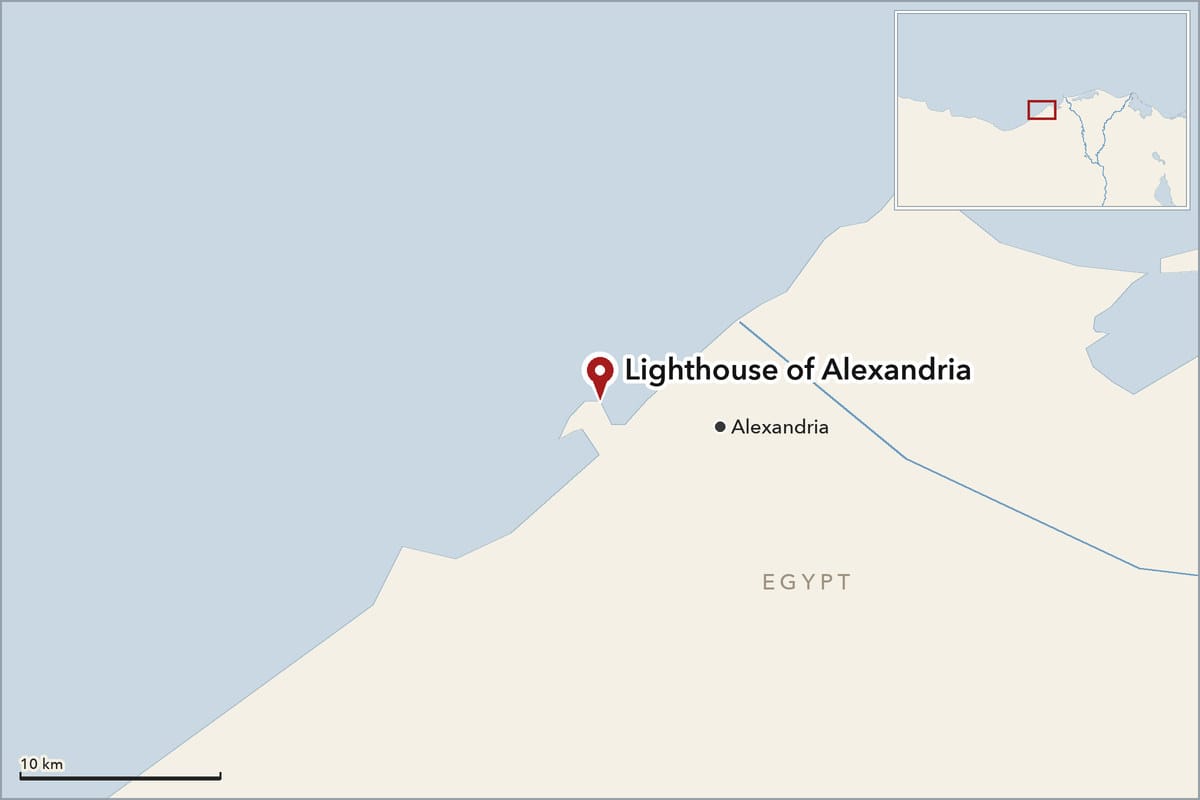
- Map: drawn from Natural Earth (public domain) and Wikidata.
