
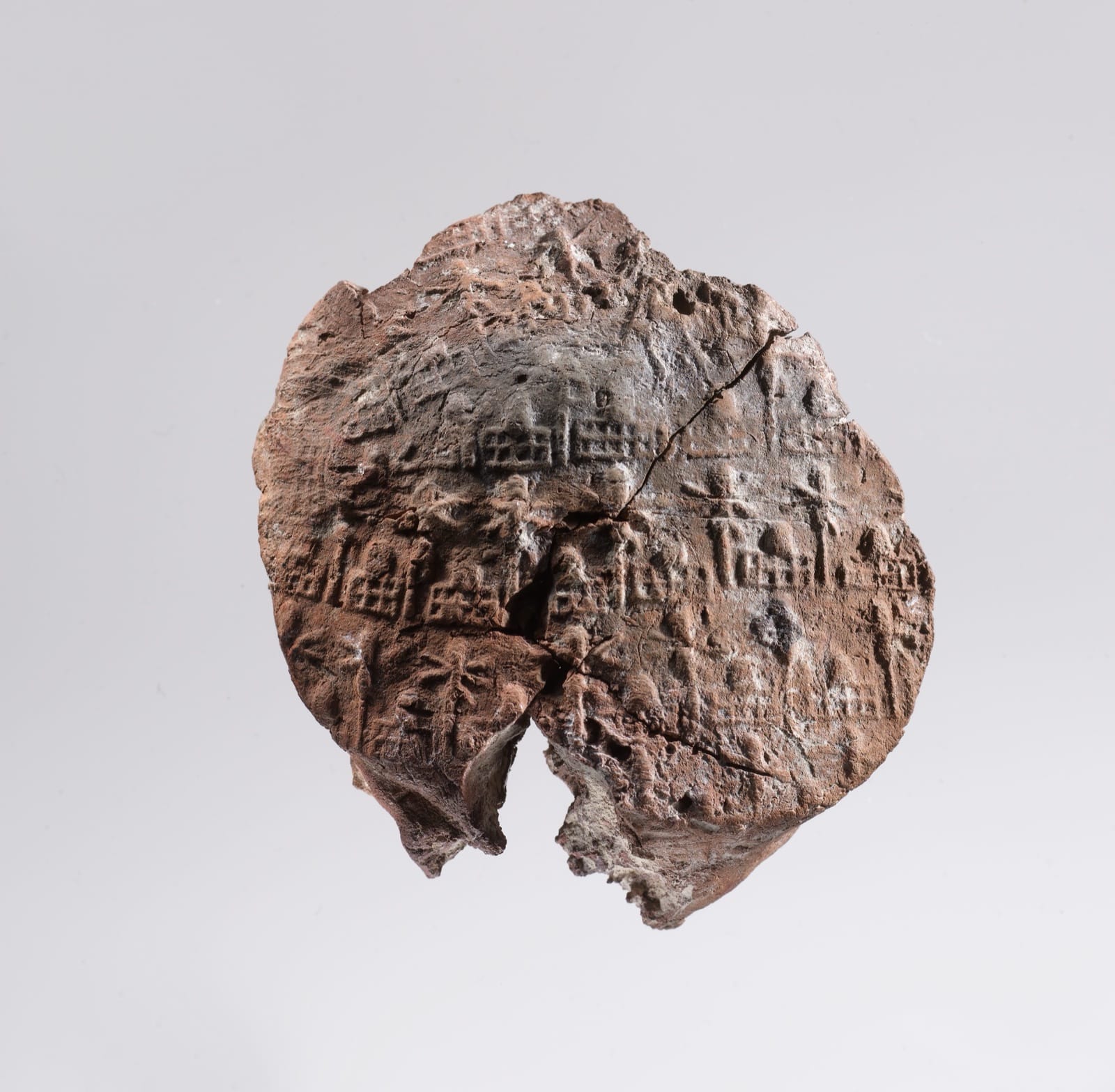
In 1946, Walter B. Emery found thirteen cone-shaped mud stoppers on the shelf and around the mouth of the shaft of Saqqara tomb S3503. Each one bore a seal impression showing a single line of four serekhs — the frame combining a royal building, a patron deity and the ruler's name that marked a ruler in this period. Emery identified the first and fourth as Djer. The second and third, he noted, did not contain Djer's name and were not surmounted by a Horus falcon.
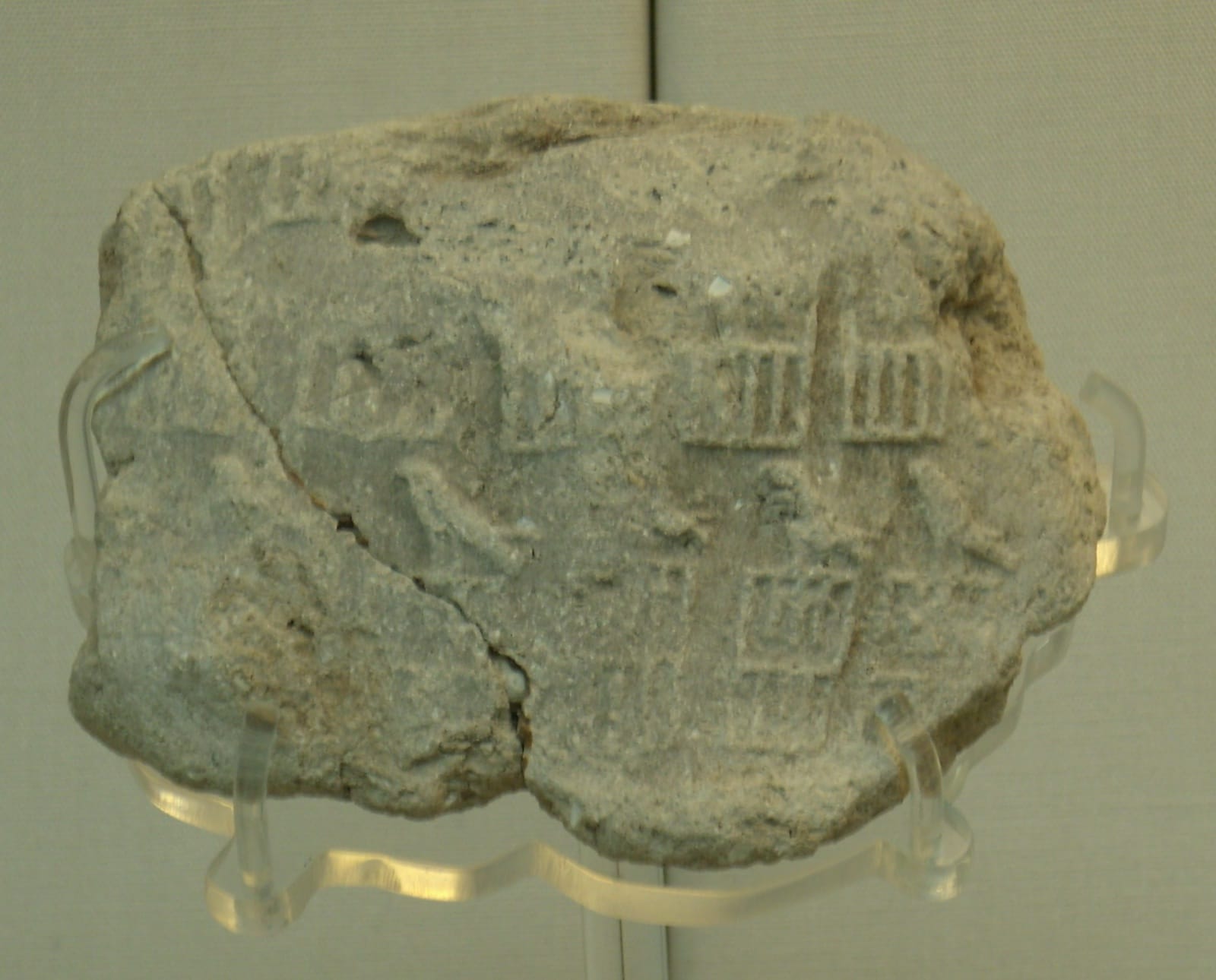
He published a black-and-white photograph of one of those impressions in his 1954 excavation report. Seven years later, in his 1961 book Archaic Egypt, he suggested the two unidentified serekhs belonged to Meretneith — a woman he had already encountered in the tomb's inscribed material, whose name appeared on stone vessels found beside the sarcophagus.
That photograph is now the only surviving evidence of the serekhs in question. The original mud stopper seal impression and Emery's glass plate from the excavation are, in the words of the paper that just re-examined them, "unknown" in their whereabouts.
That photograph, with Emery's published line drawing, is now the only evidence for a long-disputed identification: did a woman hold the serekh, the preeminent symbol of royal authority?
The constraint that shaped the debate
The problem isn't just that the original is lost. It's that the photograph is a photograph — a poor-quality 1954 image of a clay impression. You can't run Reflectance Transformation Imaging on it.
Peter Kaplony, writing in 1963, called the publication of the fragmentary sealing unconvincing. Rudolf Anthes, in 1959, didn't even consider the possibility that the serekh could belong to a female ruler, and questioned whether the two identical characters in the name compartment were actually the hoe sign at all. Silke Roth, in 1997, rejected the identification on the grounds that the doubled hoe sign in the serekh differed from how Meretneith's name was written in other epigraphical sources.
One argument against Emery's reading was that the poor quality of the published photo made it impossible to confirm what the signs depicted. Kelly and Miller put the scholarly split plainly: "Although some scholars agree that the serekhs name Meretneith (see, Vandier 1952: 989; Godron 1957: 192, fn. 5; Helck 1987: 119; Schulze 1987: 200; Callender 2011: 30; Pätznick 2017: 296–297; Engel 2021: 84–85), not all Egyptologists accept his claim."
What the new technique actually does
Sue Kelly and Crystal Miller, publishing in Prague Egyptological Studies XXXVI/2026 (Czech Institute of Egyptology, Charles University, Prague), set out to do something with that photograph that hadn't been done before. In September 2022, staff at the Egypt Exploration Society obtained high-resolution scans of Emery's original photograph using a flatbed scanner. Kelly and Miller then ran the scan through a four-step digital pipeline:
- A high-contrast threshold mask in Adobe Photoshop, separating the surface of the seal impression (white) from the clay matrix (black).
- Background removal using the magic wand tool, isolating the impression from its surroundings.
- Inversion of the colour palette, flipping the background to white and the impression to black.
- Vectorisation via the Image Trace tool, producing a resolution-independent rendering of the seal.
The result, they write, is "comparable to that of a charcoal rubbing and much more accurate than a hand illustration." It is not the original artefact. It is not RTI. It is a digitised technical illustration derived from a scan of a photograph. But it is, they argue, a significantly clearer view of the impression than the 1954 print or Emery's own line drawing.
What the enhanced image shows
Two findings matter.
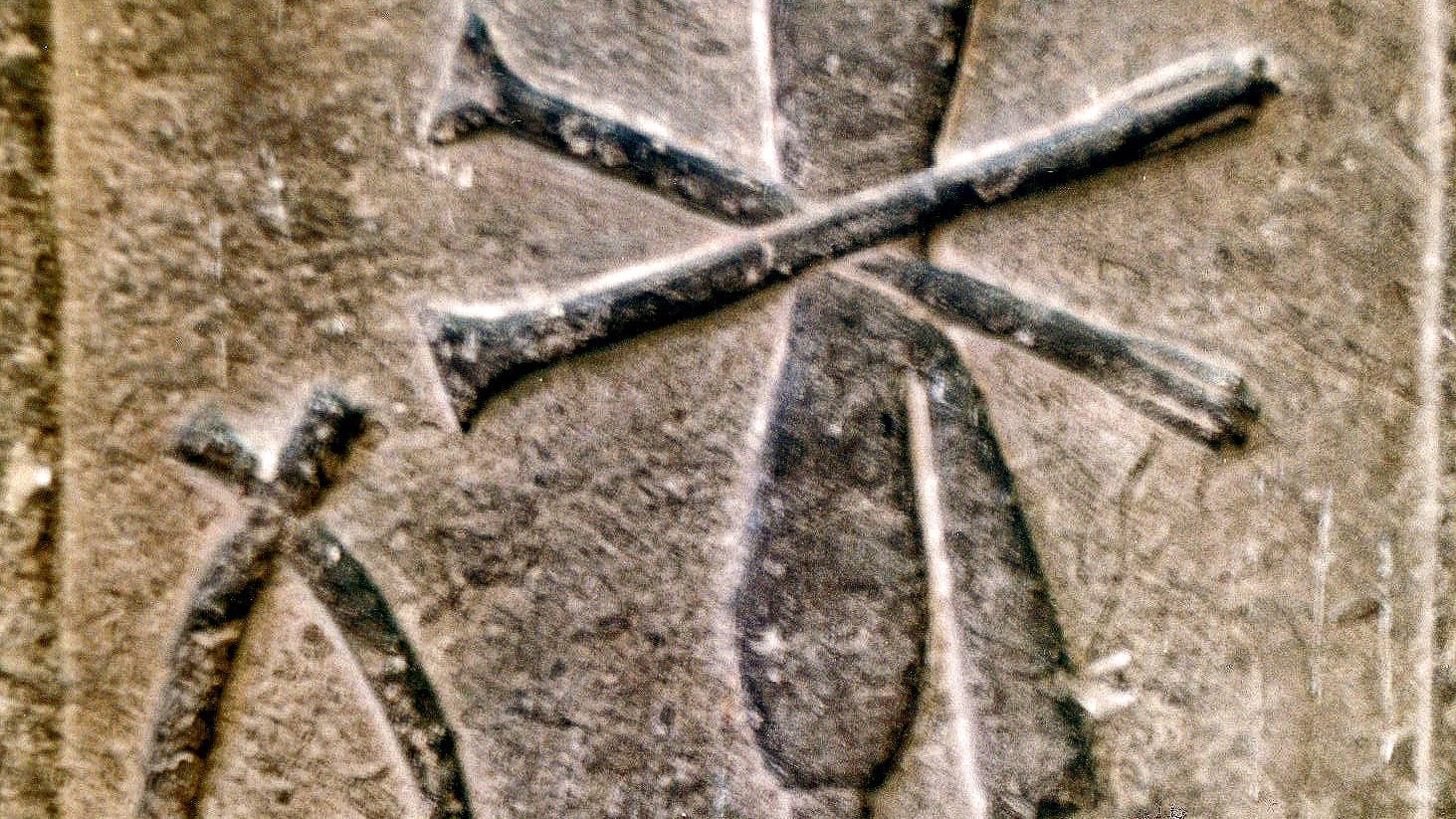
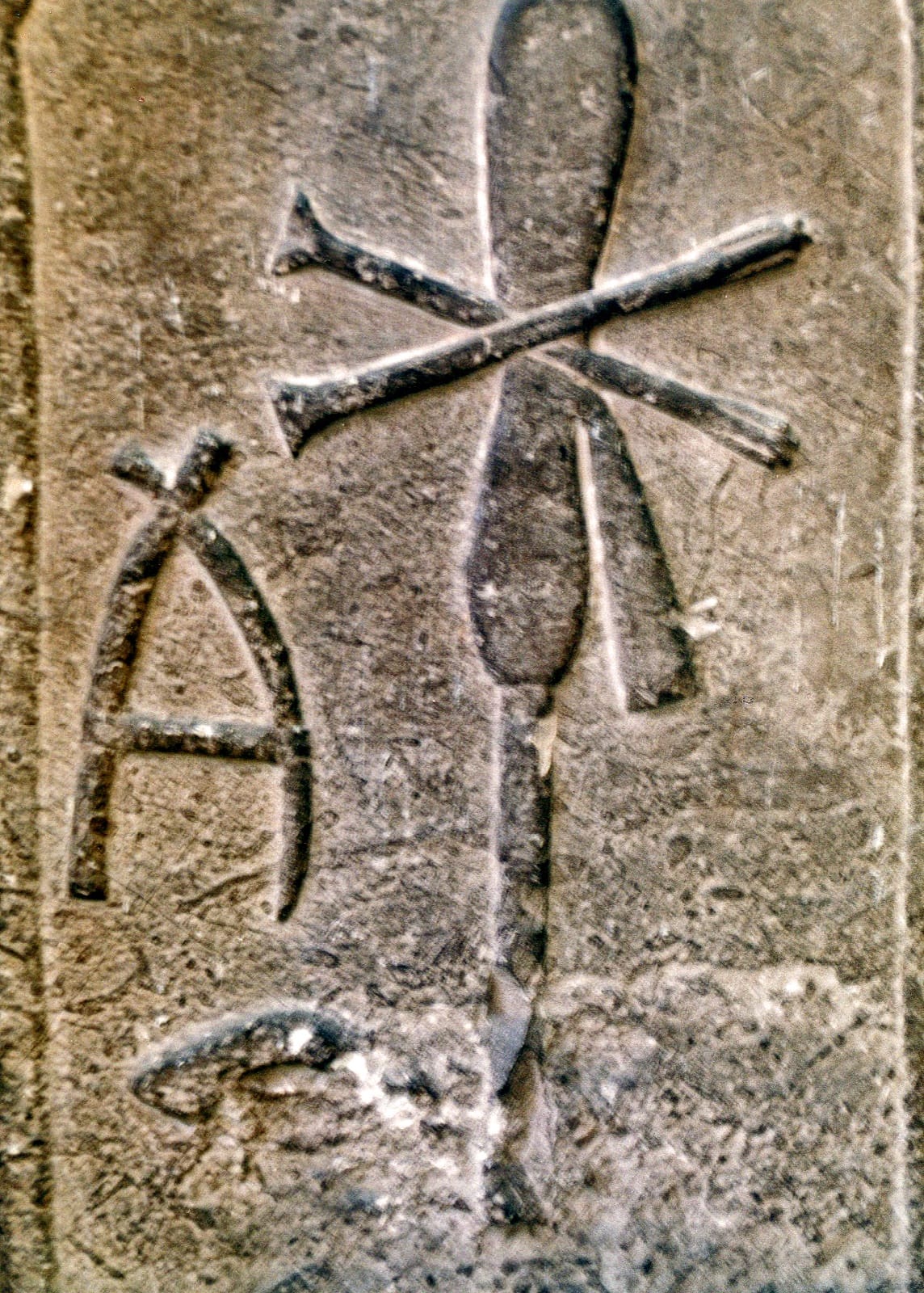
First, the second serekh, beside Djer's, shows the mr (U6) sign — the hoe — written twice in the name compartment. The authors note that the writing of the hoe sign is "remarkably similar to other inscriptions of Meretneith's name," citing examples from the Oriental Institute Museum, Kaplony's own corpus, and Petrie's 1900 plates. The Neith symbol (crossed arrows and shield) surmounts the serekh, consistent with the remnants Emery traced.
Second, the third serekh again appears to show the doubling of the hoe symbol. The first instance is misshapen; the second more clearly resembles the U6 sign. The deity atop this serekh does not, the authors note, appear consistent with the Neith symbol, and any identification of it "will remain speculative."
The digitised illustration does not support Roth's 1997 suggestion that the traces above the second serekh were positioned at the height of the falcons' heads, as a falcon's tail feathers would be. The sign, the authors write, "in no way resembles a Horus falcon." But the illustration does appear to confirm Roth's separate suggestion, made in the same 1997 article, that the falcon's legs and abdomen could be seen on the third serekh. The authors call the possibility that this is "the first known Horus female serekh" tempting, but say they "remain cautious regarding reaching that conclusion."
The verdict — and the pushback
Kelly and Miller's conclusion is direct: "Based on this latest examination, there appears little argument left to dispute that the serekh – held only by rulers – belonged to Meretneith." They read the Neith sign as "the female equivalent of the falcon on top of male serekhs," and the name as Meret.
That is their reading. It is not a settled one.
Per Live Science, Eva-Maria Engel, a historian at Humboldt University of Berlin who was not involved in the study, looked at the paper's enhanced image and does not read Meretneith's name in it: in an email to Live Science she said the seal appears to mention only King Djer. That is her reaction to the new enhancements; her own 2021 work is cited in the paper among scholars who do accept the attribution. Kaplony's 1963 objection, Anthes's 1959 scepticism and Roth's 1997 rejection all predate the new technique; only Kaplony's concerned the clarity of the publication, while Anthes and Roth questioned the reading of the signs and the spelling of the name.
The authors themselves acknowledge the field is divided. Their abstract poses the question — "Was she a co-regent with Djer, a female ruler, or a regent for the minor Den? Or was she all three?" — and the paper's answer, which it presents as a new hypothesis, is that she appears to have held distinct positions at different stages.
The bigger case
What is not in serious dispute is Meretneith's prominence. Kelly and Miller call her "a prominent figure in the First Dynasty," attested by a royal tomb and funerary enclosure, a serekh, necropolis seal impressions, and inscriptions documenting her name alongside administrative titles. She held the "king's mother" title (mwt nswt). Some scholars read a sign in her inscriptions as the title "foremost of women." The abstract raises the possibility that she was "a regent for the minor Den."
The authors frame her career as having distinct stages, in which she may have been able to step in and out of the rulership as the political environment required. The first stage, in their reading, was a co-regency with Djer — a theory built on Peter Schulze's (1987) suggestion of a crown-princess role and proposed as a co-regency by Jean-Pierre Pätznick (2017), and given additional weight by Günter Dreyer's (2021) argument, based on two ivory labels, that two rulers' names associated with a serekh on the same object can only mean co-regency. The second stage was her regency for Den, marked by the "king's mother" title on the necropolis seal from Den's tomb.
Her personal relationships remain contested. Kelly and Miller note that scholars generally consider her "to be the daughter of Djer (Lauer 1966: 176), the successor of Djet (Bestock 2008: 53), possibly his royal wife (Dodson 2012; Wilkinson 1999: 62; Pätznick 2017: 296)." The co-regency with Djer is a separate theoretical layer. The "wife" possibility attaches to Djet, not Djer.
The broader context: Neithhotep is another woman attested with a serekh (Garstang Museum E. 1335). Wolfgang Helck (1987) interpreted Neithhotep as having managed the country as a regent while Meretneith ruled as a king. Writing in The Conversation, the researchers describe Meretneith as "the second female ruler of ancient Egypt whose name was recorded in the royal serekh emblem," though that ranking has not been independently established.
What's still missing
The original mud stopper. Emery's glass plate. Both are lost, whereabouts unknown. The paper's serekh analysis rests on a 1954 photograph, scanned in 2022 and processed through a threshold-and-invert pipeline. The authors say the digital reconstruction provides significantly improved clarity over what came before. But it is still a reconstruction of a photograph of an impression, not the impression itself.
The authors argue their examination leaves little argument against the attribution. The case against it remains: Kelly and Miller's paper records earlier objections from Kaplony, Anthes and Roth, and Engel told Live Science that the enhanced image appears to name only Djer. The authors say the technique answers Kaplony's clarity concern; whether it settles the interpretive objections remains disputed, with Engel reading the seal differently.
The file is open. The evidence is better. The verdict is still contested.
Sources
Jarus, O. (2026) 'A 72-year-old photo is revealing new clues about 'Meretneith,' a powerful woman who may have ruled Egypt 5,000 years ago', Live Science, 28 September 2026, available at: https://www.livescience.com/archaeology/ancient-egyptians/a-72-year-old-photo-is-revealing-news-clues-about-meretneith-a-powerful-woman-who-may-have-ruled-egypt-5-000-years-ago (Accessed: 2 October 2026).
Kelly, S. (2026) 'Was there really a female king in ancient Egypt 5,000 years ago? New study says yes', The Conversation, 15 September 2026, available at: https://theconversation.com/was-there-really-a-female-king-in-ancient-egypt-5-000-years-ago-new-study-says-yes-290437 (Accessed: 2 October 2026).
Kelly, S. and Miller, C. (2026) 'New technology illuminating ancient evidence: re-evaluating Meretneith's serekhs and political position', Prague Egyptological Studies, XXXVI, pp. 28–49, Czech Institute of Egyptology, Faculty of Arts, Charles University, Prague, September 2026, available at: https://pes.ff.cuni.cz/wp-content/uploads/sites/13/2026/09/Sue_Kelly_%E2%80%93_Crystal_Miller_28-49.pdf (Accessed: 2 October 2026). Published under a non-commercial, attribution-required licence (CC BY-NC-ND 4.0); short quotations used here for reporting and commentary with attribution to the authors and journal.