
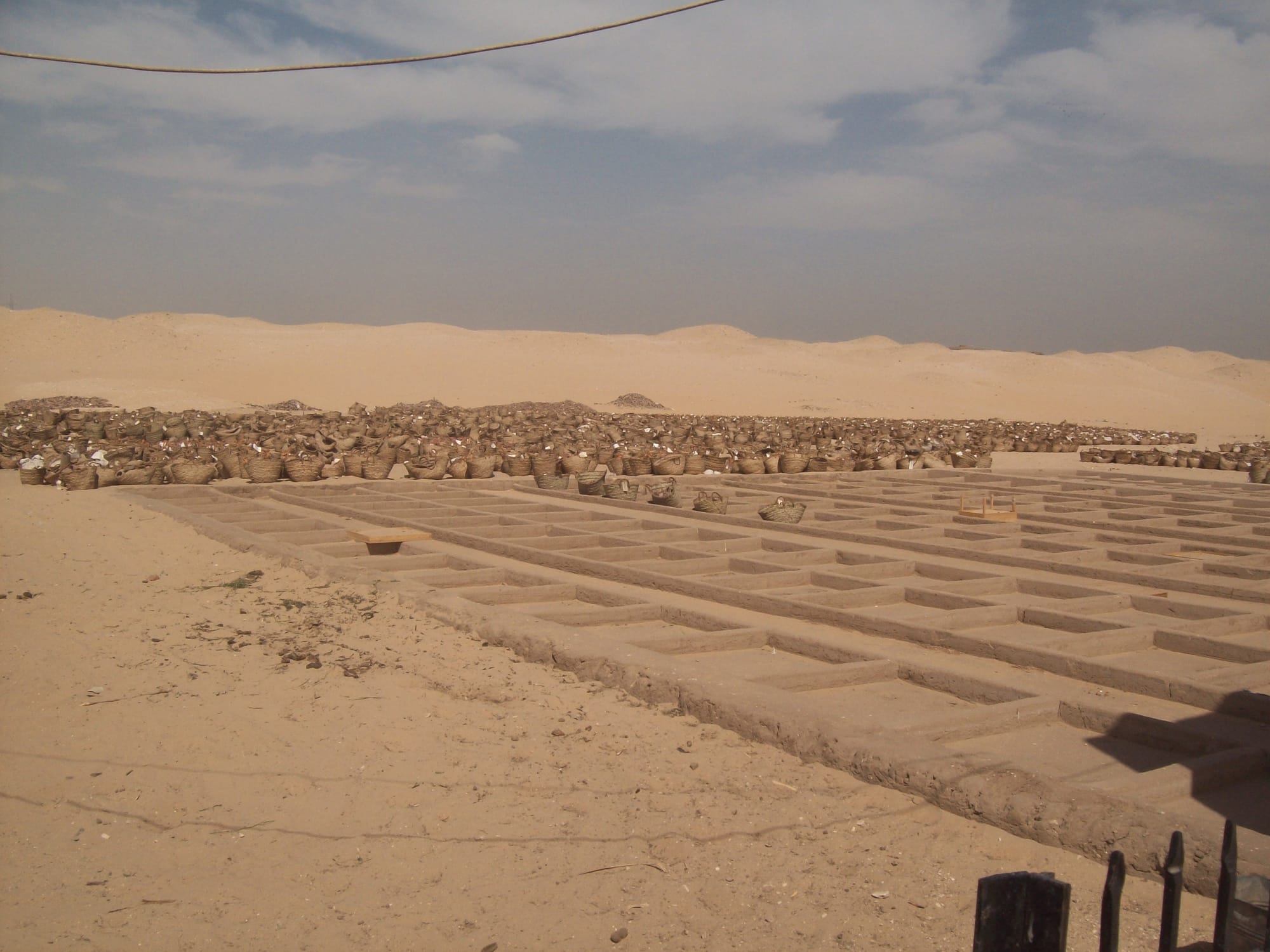
Above: Modern (2009) photograph of baskets of pottery sherds from active excavations at the Umm el-Qaab necropolis, Abydos, Egypt (26°11'N, 31°55'E). (Image: Abydos Necropolis Excavation, Kyera Giannini / ISAW (NYU), CC BY 2.0)
A century of no trauma found
Here is the thing that should bother you: for roughly a hundred years, the debate over whether these people were killed largely depended on the excavators' initial analyses of the remains. Not a bioarchaeologist's examination of the bones. Not a forensic specialist's assessment of the fracture patterns. Just: Petrie reported no trauma, and a century of debate proceeded on that basis.
The bones sat in the Duckworth Collection at Cambridge University. The interpretation sat in the literature. The remains were largely ignored for the rest of the 20th century.
Roselyn Campbell of Purdue University published a paper in Frontiers in Environmental Archaeology revisiting her trauma findings; she told The Guardian her work was the first study to look at trauma and cause of death while examining human remains from the tombs. Prior work on these collections — Keita and Boyce's 2006 study of cribra orbitalia, Keita's population studies — addressed different questions.
What Petrie found, and what he didn't
Flinders Petrie excavated the subsidiary burials around the First Dynasty funerary enclosures in the early 1920s. The context: hundreds of single-interment graves clustered around the tombs and enclosures of First Dynasty kings Djer, Djet, and the queen-regent Merneith. Some graves bore name and title markers identifying the occupants as low- to mid-level officials — seal-bearers, inspectors, artisans. Many of the graves seem to have been filled and sealed in a single event, apparently hastily. The number was enormous.
Petrie's conclusion: retainer sacrifice. He believed the simultaneous closure of so many graves made individual natural deaths unlikely, and the courtly identities of the buried individuals pointed to people killed to serve their ruler in the afterlife.
But he found no evidence of lethal trauma in the skeletons. And that absence became a central plank of the counter-argument, alongside Reisner's observation that many graves were sealed individually. Hikade and Roy (2015) and Tyldesley (2000) proposed that the individuals died naturally and were deposited around the tomb over time. Petrie himself, noting the unusual position of several bodies with limbs outstretched, hypothesised that many or all had been buried alive.
None of those positions rested on a modern, expert re-examination of the bones. As Campbell's paper puts it, "both sides of this argument have proceeded without an updated, expert analysis of the human remains."
What Campbell found
Campbell located 46 crania in the Duckworth Collection — the subset of Petrie's finds that ended up in Cambridge, excluding two individuals represented only by mandibles. She assessed them for perimortem trauma using current forensic and bioarchaeological methods.
The result: 18 of the 46 crania — 39% — showed evidence of perimortem, potentially lethal cranial trauma. Linear fractures across the cranial vault were the most common injury. Some of the 18 skulls also bore sharp-force injuries, including a penetrative wound to the side of the head and a chopping injury to the eye.
The Frontiers news release summarises the finding as indicating that "at least 39% of these individuals may have been deliberately killed by blows to the head." The paper itself is slightly more measured: "it is also clear that many of these individuals did experience perimortem trauma of some kind." The trauma is the finding. The deliberate-killing interpretation is the inference drawn from it — by the press release, and in part by Campbell herself: her paper points to forensic work showing that fractures above the 'hat-brim' line tend to come from intentional blows rather than falls. Both are defensible.
The weapon question
This is where it gets specific, and where the tempting idea of a mace starts to look unsatisfactory. Egyptian kings are routinely depicted smiting enemies with a mace. But a mace would cause significant depressed fractures. What Campbell found was linear fractures: long, spreading cracks across the vault.
Linear fractures are "generally caused by a flat, wide weapon, or a fall," the Frontiers release states, though a fall hard enough to fracture the skull would probably have broken other bones. The fractures are more likely to have been caused by flat, wide objects made of wood or antler, The Guardian reported, though Campbell told Ars Technica "it's really hard to say specifically." She also addressed Petrie's own speculation that a sandbag might have been used: "sandbags are very heavy, and I think the force required to swing a large sandbag might have caused more damage."
Probably something flat and wide rather than the mace of the royal smiting scenes. Campbell's own guess is modest: "It could be as simple as a board… you could easily fashion some kind of wooden club."
What we still can't say
Campbell is careful, and the caveats matter. The 46 crania represent between 5% and 15% of the total burial populations at each enclosure. The postcranial remains are gone — reburied, commingled, lost. Campbell told The Guardian: "For the crania without trauma, we cannot be certain they were sacrificed." They may have died naturally. Scholars have suggested asphyxiation, strangulation, or poisoning; they may also have been killed in ways that would show only on the missing rest of the skeleton. The sample may not be representative.
This finding does not close the case. It suggests that evidence available all along was probably misread.
The broader picture
Salima Ikram, a professor at the American University in Cairo, told The Guardian that "this paper is one of the few times that rigorous current methodologies are being used to evaluate these remains." On the retainers themselves, she offered a more human frame: "Possibly some or all retainers felt that this was a boon… though they might also have resented it, been terrified, and tried to escape this fate."
Dawn McCormack, an Egyptologist at Samford University in Alabama, told The Guardian that similar sacrifices had occurred across different cultures and times, and that "the idea that some of the people may have been violently killed, I think, is something that in reality we might expect."
Campbell herself pointed to the economics. "It is economically very costly to kill off hundreds of people every 20 to 40 years. That's not really sustainable," she told Ars Technica. The number of subsidiary graves, the paper notes, tapered off quickly and seems to have disappeared with the beginning of the Second Dynasty; Ikram told The Guardian that people were replaced by statuettes. It was, in Ikram's words, short-lived.

The verdict
This is not a conspiracy. There is no suppressed evidence, no hidden archive, no institution actively protecting a narrative. The failure is more mundane: a careful excavator in the 1920s likely saw the fractures, took them for damage that happened after death, reported no trauma, and that report became the literature. And for a hundred years, the question of whether they were killed was answered by reference to a man who didn't have the forensic vocabulary to recognise the answer sitting in front of him.
Campbell told Ars Technica: "I don't think he missed them because he was a pretty careful observer… He just didn't know what he was looking at. It's only in the past few decades that we've gotten a much clearer understanding of how to differentiate the timing of an injury."
Not malice. Not gatekeeping in the dramatic sense. Part of it, the paper suggests, is that interpretations have rested on earlier excavators' opinions, while older collections languished in storerooms as new material kept arriving. The bones were there. The fractures were there. The vocabulary to read them arrived a century late.
Campbell is also the author of a forthcoming book, State-sanctioned Violence and Human Sacrifice in Early Dynastic Egypt (Routledge Press). She hopes the study will inspire other specialists to revisit their predecessors' findings with updated methods.
Sources
Campbell, R.A. (2026) 'New data from old bones: using bioarchaeology and forensics to reassess legacy data from ancient Abydos, Egypt', Frontiers in Environmental Archaeology, 5, 5 October 2026, available at: https://www.frontiersin.org/journals/environmental-archaeology/articles/10.3389/fearc.2026.1858940 (Accessed: 7 October 2026).
Frontiers Media (2026) 'Modern forensic methods reveal human sacrifice in ancient Egypt', Frontiers, 5 October 2026, available at: https://www.frontiersin.org/news/2026/10/05/modern-forensic-methods-human-sacrifice-ancient-egypt-frontiers-environmental-archaeology (Accessed: 7 October 2026).
The Guardian (2026) 'Skull fractures suggest servants of Egypt's ancient kings were sacrificed', 5 October 2026, available at: https://www.theguardian.com/science/2026/oct/05/skull-fractures-suggest-servants-of-egypts-ancient-kings-were-sacrificed (Accessed: 7 October 2026).
Ouellette, J. (2026) 'New forensic evidence supports Egyptian "retainer sacrifice"', Ars Technica, 5 October 2026, available at: https://arstechnica.com/science/2026/10/new-forensice-evidence-supports-egyptian-retainer-sacrifice/ (Accessed: 7 October 2026).